Poplars not far from Oxford
The Binsey Poplars
Gerard Manley Hopkins
The Binsey Poplars
My aspens dear, whose airy cages quelled,
Quelled or quenched in leaves the leaping sun,
All felled, felled, are all felled;
Of a fresh and following folded rank
Not spared, not one
That dandled a sandalled
Shadow that swam or sank
On meadow & river & wind-wandering weed-winding bank.
O if we but knew what we do
When we delve or hew —
Hack and rack the growing green!
Since country is so tender
To touch, her being só slender,
That, like this sleek and seeing ball
But a prick will make no eye at all,
Where we, even where we mean
To mend her we end her,
When we hew or delve:
After-comers cannot guess the beauty been.
Ten or twelve, only ten or twelve
Strokes of havoc unselve
The sweet especial scene,
Rural scene, a rural scene,
Sweet especial rural scene.
Poplars not far from Oxford
My poplars! You with airy grids thick-grown
To chloroform with chlorophyll Sir Sun,
Him bounding, you now all cut down, cut down;
Yours was a vigorous and tight-knit rank,
To nought now, no, you shrank,
That swung a so low-slung
Shadow that swam or sank
On turf and brook and wind-wild woodbin’d bank.
O did you and I but know how to stop
Who dig and chop –
Hack and rack all things that natural grow!
So soft is country’s naturism
To touch, inasmuch as lissom –
Just so, this smooth and sighting ball:
But a prick, and it’s not optical –
Where we, even where we pretend
We’d mend her, we end her,
When we delve, when we hew:
Today, tomorrow, coming folk won’t know
How much glory has had to go.
Just six and six, or six and two and two
Struck blows of havoc could undo
That singular most mystic
Vista rustic, vista rustic,
That vista rustic, oh, most mystic.
Translation: Copyright © Timothy Adès
More poems by Gerard Manley Hopkins...
I live in “Perhaps”
Ich lebe im "Vielleicht"
Emmy Ball-Hennings (1888-1948)
Ich lebe im "Vielleicht"
Ich lebe im „Vielleicht“,
Bin eine stumme Frage
Und alles ist mir Sage,
Soweit Gedanke reicht.
O komm, geliebtes Schweigen,
Und hüll mich zärtlich ein.
Wird alles anders sein,
Will ich mich tiefer neigen.
I live in “Perhaps”
I live in “Perhaps”,
I’m just a mute query:
All things are a story
Till Thought overlaps.
Come, lovable Silence,
With tender embrace:
Transform! I’ll abase
To deeper obeisance.
Translation: Copyright © Timothy Adès
More poems by Emmy Ball-Hennings...
Faiths and Creeds, what good to me?
Ach, was soll mir all Bekennen
Emmy Ball-Hennings (1888-1948)
Ach, was soll mir all Bekennen
Ach, was soll mir all Bekennen,
Schönes Schweigen, hüll mich ein.
Trunken in mir selber brennen,
Will ich Rausch und Säule sein.
Wort und Namen – wozu nennen?
Nicht mehr hören, nicht mehr sehn,
Wenn des Lebens bunte Chöre
Klingend mir vorüberwehn.
Nur die Siegel mögen brennen
Tief in meiner Seele Grund.
Daß ich Katakombe wäre,
Flamme, Gold und Gottesmund . . .
Faiths and Creeds, what good to me?
Faiths and creeds, what good to me?
Lovely Silence, swaddle me.
Scorched within me, drunkenly,
A pillar wild with wine I’ll be.
Wherefore utter name or word?
Nothing more I’ll hear and see,
When life’s joyous choirs are heard
Wafting music over me.
Let the seals with wax be seared
In my soul’s profundity.
Flame and gold I would become,
Mouth of God, and catacomb.
Translation: Copyright © Timothy Adès
More poems by Emmy Ball-Hennings...
for Hugo Ball
für Hugo Ball
Emmy Ball-Hennings (1888-1948)
für Hugo Ball
Oktaven taumeln Echo nach durch graue Jahre.
Hochaufgetürmte Tage stürzen ein.
Dein will ich sein -
Im Grabe wachsen meine gelben Haare
Und in Holunderbäumen leben fremde Völker
Ein blasser Vorhang raunt von einem Mord
Zwei Augen irren ruhelos durchs Zimmer
Gepenster gehen um beim Küchenbord.
Und kleine Tannen sind verstorbene Kinder
Uralte Eichen sind die Seelen müder Greise
Die flüstern die Geschichte des verfehlten Lebens.
Der Klintekongensee singt eine alte Weise.
Ich war nicht vor dem bösen Blick gefeit
Da krochen Neger aus der Wasserkanne,
Das bunte Bild im Märchenbuch, die rote Hanne
Hat einst verzaubert mich für alle Ewigkeit.
for Hugo Ball
Octaves go whirling echoes through grey years.
Days tumble down heaped up in lofty towers.
Let me be yours.
Still growing in the grave my yellow hairs
And foreign tribes lnhabit elder-trees
Pale curtain whispers murder is the word
Two eyes roam restlessly across the room
And spectres circle at the kitchen-board.
Small fir-trees too are children who have died
And ancient oaks are souls of weary crones
Who mutter histories of lives that failed.
Lake Klintekongen sings an age-old tune.
The evil eye I never was immune
The water-cans were full of Africans
Storybook picture bright Red Hannah she
Bewitched me once for all eternity.

Translation: Copyright © Timothy Adès
More poems by Emmy Ball-Hennings...
Summer's End
Sommers Ende
Hermann Hesse (1877-1962)
Sommers Ende
Gleichtönig, leis und klagend rinnt
Den lauen Abend lang der Regen,
Hinweinend wie ein müdes Kind
Der nahen Mitternacht entgegen.
Der Sommer, seiner Feste müd,
Hält seinen Kranz in welken Händen
Und wirft ihn weg -- er ist verblüht --
Und neigt sich bang und will verenden.
Auch unsre Liebe war ein Kranz
Auflodernd heißer Sommerfeste,
Nun löst sich sacht der letzte Tanz,
Der Regen stürzt, es fliehn die Gäste.
Und eh wir der verwelkten Pracht
Und der erloschenen Glut uns schämen,
Laß uns in dieser ernsten Nacht
Von unsrer Liebe Abschied nehmen.
Summer's End
Dreary rain, complaining, mild
Through the evening drear
Whining like a weary child,
Midnight drawing near.
Summer wearies of his feasts,
Drooping hand drops wilted wreath,
Sadly bending, gladly ending.
And our love, another wreath,
Flared in heat of summer’s feasts:
Last dance gently dissipates,
Pouring rain and fleeing guests.
Splendour’s blighted: quenched, the blaze:
Unashamed that times were bright,
Let us in this earnest night
Leave our love and go our ways.
Translation: Copyright © Timothy Adès
More poems by Hermann Hesse...
Butterfly and Rose
Schmetterling und Rose
Heinrich Heine (1797-1856)
Schmetterling und Rose
Der Schmetterling ist in die Rose verliebt,
Umflattert sie tausendmal,
Ihn selber aber, goldig zart,
Umflattert der liebende Sonnenstrahl.
Jedoch, in wen ist die Rose verliebt?
Das wüßt ich gar zu gern.
Ist es die singende Nachtigall?
Ist es der schweigende Abendstern?
Ich weiß nicht, in wen die Rose verliebt;
Ich aber lieb euch all':
Rose, Schmetterling, Sonnenstrahl,
Abendstern und Nachtigall.
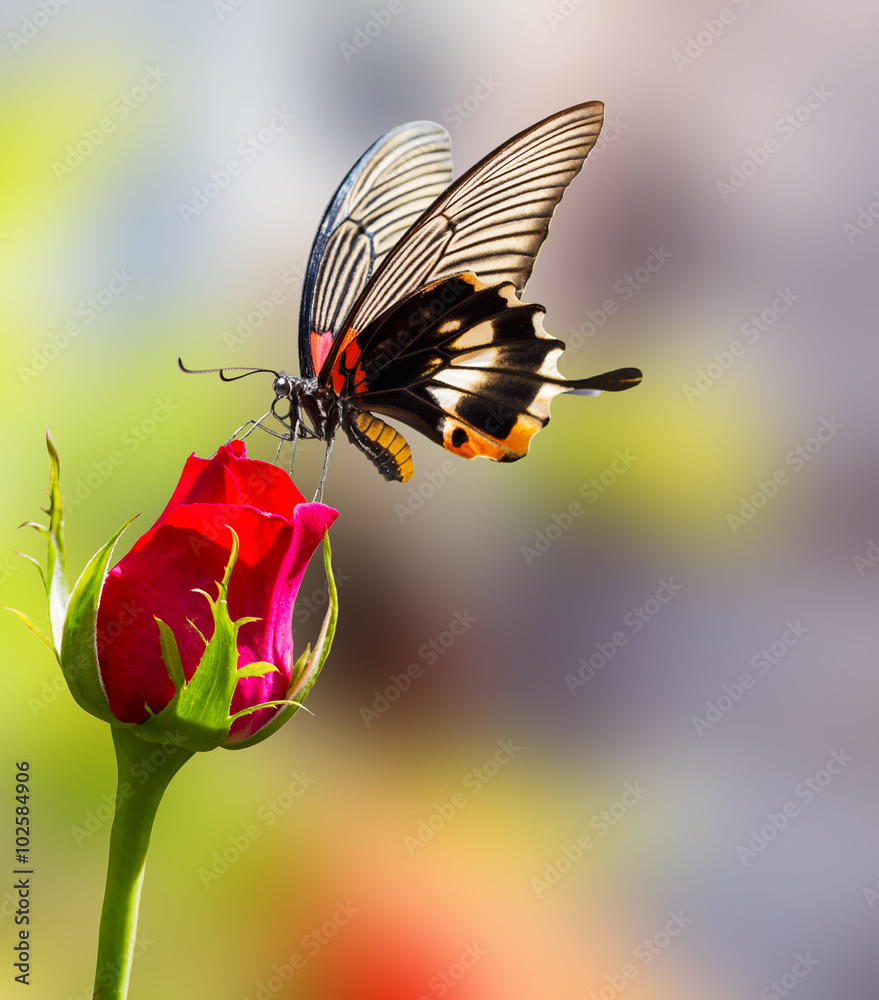
Butterfly and Rose
The butterfly flutters a thousand times
around the rose he loves,
and round the butterfly tenderly
the golden sunbeam roves.
But this I would gladly, gladly know:
who does the rose desire?
Is it the singing nightingale
or the silent evening star?
I know not who is the rose’s love,
but I love all of you:
rose and butterfly, evening star,
nightingale, sunbeam too.
Translation: Copyright © Timothy Adès
More poems by Heinrich Heine...