Fantasio

Categories
French

Fantasio

André Bellessort (1866-1942)

La mort t'ayant surpris en travesti de bal, Pauvre Fantasio, de folles jeunes filles Te firent un linceul de leurs blanches mantilles, Et tu fus enterré le soir du carnaval. Sous un léger brouillard du ciel occidental Le mardi gras folâtre éparpillait ses trilles, Et ton glas, voltigeant sur de lointains quadrilles, Détachait dans la nuit ses notes de cristal. Des coins du corbillard le feu des girandoles Éclairait tout un chœur d'étranges farandoles. Nul n'avait pris le temps de revêtir le deuil. Ta rieuse maîtresse avait gardé son masque Et tous faisaient jouer derrière ton cercueil Une marche funèbre à leurs tambours de basque.
Fantasio
Death caught you costumed for the fancy ball. Giddy young women (Poor Fantasio!) lent you their white mantillas for a pall: they buried you, that night of carnival. In the slight vapour of the western sky mad Mardi Gras went frittering its trills; Your death-knell pranced on faraway quadrilles, etched on the night its crystal threnody. The flames of candelabra round the bier lit dancers reeling in an eerie choir. No-one had paused to dress in mourning-gear. Your laughing mistress kept her mask, and all followed your corse and, played, Fantasio, on tambourines, a march funereal.

Translation: Copyright © Timothy Adès

More poems by André Bellessort...

Leda and the Swan

Leda and the Swan

W. B. Yeats (1865-1939)

Latin translation by Timothy Adès
Leda and the Swan
A sudden blow: the great wings beating still Above the staggering girl, her thighs caressed By the dark webs, her nape caught in his bill, He holds her helpless breast upon his breast. How can those terrified vague fingers push The feathered glory from her loosening thighs? And how can body, laid in that white rush, But feel the strange heart beating where it lies? A shudder in the loins engenders there The broken wall, the burning roof and tower And Agamemnon dead.     Being so caught up, So mastered by the brute blood of the air, Did she put on his knowledge with his power Before the indifferent beak could let her drop?
Leda and the Swan
vi subita ignaram ferit ille, alasque tremendis   ictibus en supra, dum labat ipsa, ciet ; collum inhibet rostro, femora et cute mulcet opaca,   et gremium gremio prendit inerme suo. num manus imbellis pinnatum arcere nitorem,   territa num fluido tollere crure potest? labitur incursu niveo; mirabile sentit,   qua iacet, ad costas, cor resonare suas. confractos muros, ustam cum culmine turrim,   et motum ile necem gignit, Atrida, tuam. sic ferus aurarum sanguis superavit amatam,   rostraque sic captae denique laxat iners. num mihi Thestiadae dedit et prognoscere fatum,   quod dederat caeco corpore ferre Tonans?

Translation: Copyright © Timothy Adès

More poems by W. B. Yeats...

Oak Ash and Thorn by Timothy Adès

Oak Ash and Thorn by Kipling

Rudyard Kipling (1865-1936)

A song for anybody to sing without avoiding A, I, O, or U
Oak Ash and Thorn by Kipling
Of all the trees that grow so fair Old England to adorn Greater are none beneath the sun Than oak and ash and thorn Sing oak and ash and thorn good sirs All on a midsummer's morn Surely we sing of no little thing In oak and ash and thorn Oak of the clay lived many a day Or ever Aeneas began Ash of the loam was a lady at home When Brut was an outlaw man Thorn of the Down saw New Troy Town From which was London born Witness hereby the ancientry Of oak and ash and thorn Sing oak and ash and thorn good sirs All of a midsummer's morn Surely we sing of no little thing In oak and ash and thorn Yew that is old in churchyard mould He breedeth a mighty bow Alder for shoes do wise men choose And beech for cups also But when you have killed and your bowl is spilled And your shoes are clean outworn Back ye must speed for all that ye need To oak and ash and thorn Sing oak and ash and thorn good sirs All of a midsummer's morn Surely we sing of no little thing In oak and ash and thorn Ellum she hates mankind and waits Till every gust be laid To drop a limb on the head of him Who any way trusts her shade But whether a lad be sober or sad Or mellow with ale from the horn He'll take no wrong when he lieth along 'Neath oak and ash and thorn Sing oak and ash and thorn good sirs All of a midsummer's morn Surely we sing of no little thing In oak and ash and thorn Oh do not tell the priest our plight Or he would call it a sin But we've been out in the woods all night A-conjuring summer in And we bring you news by word of mouth Good news for cattle and corn Now is the sun come up from the south with oak and ash and thorn Sing oak and ash and thorn good sirs All of a midsummer's morn England shall bide till Judgement Tide By oak and ash and thorn.
Oak Ash and Thorn by Timothy Adès
Of trunks and boughs which Luck allows Fair Albion to adorn, Naught is so grand in all our land As oak and ash and thorn. Sing oak and ash and thorn, good sirs, All on a long day’s morn: Good folk shall sing, no paltry thing, Of oak and ash and thorn. OAK on our clay saw stop and stay Troy’s pious lord forlorn; ASH on our loam saw Brutus roam, An outlaw put to scorn; THORN on our Down saw young Troy Town, From which was London born. Thus all may know that long ago Stood oak and ash and thorn. - Sing oak and ash and thorn, good sirs, All on a long day’s morn: Good folk shall sing, no paltry thing, Of oak and ash and thorn. TAXUS grows old in churchyard mould And spawns a mighty bow; ALNUS is put on snug-shod foot, FAGUS to cups will go; A kingdom’s built, a bowl is spilt, A boot’s cast off, outworn: You shall go back for what you lack To oak and ash and thorn. - Sing oak and ash and thorn, good sirs, All on a long day’s morn: Good folk shall sing, no paltry thing, Of oak and ash and thorn. ULMUS abhors mankind, and waits In calm, if not in storm, To drop a limb on top of him Who trusts that shady form. But any lad who’s spry or sad Or high on hops from horn Cannot go wrong by lying long In oak and ash and thorn. - Sing oak and ash and thorn, good sirs, All on a long day’s morn Good folk shall sing, no paltry thing, Of oak and ash and thorn. Blurt to no parson of our plight: A parson calls it sin, Our frolicking in woods all night To summon long days in. Glad tidings run by word of mouth Of joy for cow and corn, For now Sir Sun strolls up from south With oak and ash and thorn. - Sing oak and ash and thorn, good sirs, All on a long day’s morn: Fair Albion shall not pass away With oak and ash and thorn!

Translation: Copyright © Timothy Adès

More poems by Rudyard Kipling...

Leaves and Tomcats

Categories
German

Leaves and Tomcats

Otto Julius Bierbaum (1865-1910)

Im Mai sind alle Blätter grün, im Mai sind alle Kater kühn. Drum wer ein Herz hat, faßt sich eins, und wer sich keins faßt, hat auch keins.
Leaves and Tomcats
In May, leaves are green, Tomcats in May are keen. Who has a heart, wins one; Who wins no heart, has none.

Translation: Copyright © Timothy Adès

More poems by Otto Julius Bierbaum...

I saw the Christ-child! Imagine it, though

Denkt Euch, ich habe das Christkind gesehn

Anna Ritter (1865-1921)

Denkt Euch, ich habe das Christkind gesehn
Denkt Euch, ich habe das Christkind gesehn. Es kam aus dem Walde, das Mützchen voll Schnee, mit rotgefrorenem Näschen. Die kleine Hände taten ihm weh, denn es trug einen Sack, der war gar schwer, schleppte und polterte hinter ihm her. Was drin war, möchtet ihr wissen? Ihr Naseweise, ihr Schelmenpack - denkt ihr, er wäre offen, der Sack? Zugebunden bis oben hin! doch war gewiß etwas Schönes drin! Es roch so nach Äpfeln und Nüssen!
I saw the Christ-child! Imagine it, though
I saw the Christ-child! Imagine it, though – He came from the wood with his cap full of snow, His poor little nose red and frozen. His little hands ached from a heavy load He had a sack that he toted and towed It dragged along loudly behind him. What was in it, you’d like to know? You nosey parkers, you rascal-pack, Do you suppose it was open, the sack? All the way up it was tightly tied. But something good was surely inside – Such a scent of apples and nuts!

Translation: Copyright © Timothy Adès

More poems by Anna Ritter...

Expecting...

Erwartung...

Hedwig Lachmann (1865-1918)

She was the grandmother of the director and comedian, Mike Nichols.
Erwartung...
Eine Mutter denkt: Kind in meinem Schoß! Wie mein Blut dich tränkt, So wächst dir ein Los. Eine Mutter denkt: Kind aus meinem Schoß! Nun du mir geschenkt, Wächst in dir mein Los. Eine Mutter denkt: Kind in meinem Schoß ...
Expecting...
A mother’s theme: Child in my womb, My blood its food: Its life will come. A mother’s theme: Child from my womb, Given by heaven: My life will come. A mother’s theme: Child in my womb…
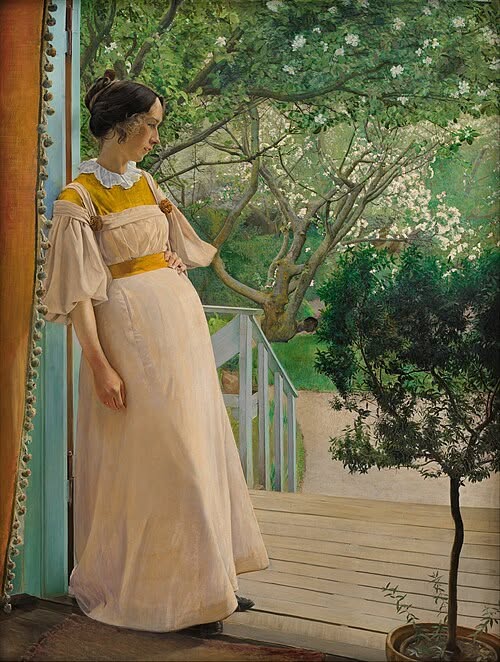
Painting: *At the French Windows* by Lauritz Andersen Ring, 1897.

Translation: Copyright © Timothy Adès

More poems by Hedwig Lachmann...

Kaiserstadt Wien

Categories
German

Kaiserstadt Wien

Ricarda Huch (1864-1947)

Kaiserstadt Wien! Ruhmvolles Haupt, Zärtlich und kühn, Lorbeer- und Rebenbelaubt. Stromauf, stromab Völker dir knien, Schwingst du den Stab, Herrscherin, Zauberin Wien. Stolz deinen Dom Adler umziehn, Nixen im Strom Singen in Schlummer dich, Wien. Kaiserstadt Wien, Kronenberaubt, Ewiges Grün Schlingt dir die Liebe ums Haupt.
Kaiserstadt Wien
Kaiserstadt Wien! Mistress renowned, Brave and serene, Vintage-bedecked, laurel-crowned. Upstream and down, Peoples obey, Kneel to the crown; Empress, enchantress, hold sway. Eagles aloft Wreathe your great spire; River flows soft, Sprites are your lullaby-choir. Kaiserstadt Wien, Sceptreless now; Love ever green Circles, immortal, your brow.

Translation: Copyright © Timothy Adès

More poems by Ricarda Huch...

STRALSUND

STRALSUND

Ricarda Huch (1864-1947)

STRALSUND
Altgraue Stadt, die das Meer umblaut, Wo das rostrote Segel sich bläht, Aufblitzt der Fische blanke Haut Und die gaukelnde Möwe kräht. Es brandet um der Kirche Wall Vergebens Well und Sturm, Sie zittert wohl von der Orgel Schall, Kein Feind stürzt ihren Turm. Die Wolken mit zartem Flügelschlag Streifen ihr Haupt, drin wühlt Ein Traum von zorniger Schlachten Tag, Wo Blut ihren Fuss umspült. Da liegen die Toten Stein bei Stein, Die Glocken summen dazu: Ewiges Gedächtnis, mein Sohn, sei dein, Ewige, ewige Ruh!
STRALSUND
The old grey town that blue sea girds: The swell of rust-red sails, The squawking, tumbling salt-sea birds, The flash of clean fish-scales. On this church wall the pounding wave And tempest waste their fire: Though organ-thunder shakes the nave, No foe hurls down the spire. The clouds with tender beating wing Caress its head, that dreams Of fierce-fought battles reddening Its foot with gory streams. The dead are sleeping, stone by stone, The sounding bells request: Eternal memory, my son, Be thine, eternal rest!

Translation: Copyright © Timothy Adès

More poems by Ricarda Huch...

To Our Martyrs

An unsere Martyrer

Ricarda Huch (1864-1947)

Ricarda Huch, a writer with seven Nobel Prize nominations, was in her eightieth year in 1943 when the White Rose group of students, Sophie Scholl and her companions, were executed for distributing leaflets calling for peace.
An unsere Martyrer
Schmerzen, unsägliche, litt der griechische Heros, bevor er Sterben durfte und die erlösende Flamme noch schmerzte. Meine Helden, geliebte, ihr littet schwerer als jene, Schmachvoll, gemartert, verhöhnt, von keinem Freude getröstet. Ihr, die das Leben gabt für des Volkes Freiheit und Ehre, Nicht erhob sie das Volk,euch Freiheit und Leben zu retten. Ach, wo seid ihr, daß wir eure Wunden mit Tränen der Reue Waschen und eure bleichen Stirnen mit Lorbeer krönen! Weilt ihr jetzt auf der Insel in ferner, seliger Bläue, Wo die Sirenen des Meers euch mit Gesängen umschwärmen? Oder droben im reinen, himmlischen Äther? Ihr wandelt Herrlich wie das Gestirn seine melodische Bahn. Wir aber wollen Male richten euch zum Gedächtnis; Wo auf Hügeln stürmische Eichen grünen, und wo die Silberne Buche ragt und die rötliche Kiefer am Meere, Stehe der Marmor und glühe die Flamme der heiligen Namen. Dort, ihr Glorreichen, wollen wir euer gedenken und schwören, Tapfer wie ihr zu sein, dem Recht und der Freiheit zu dienen, Niemals treulos und feige den Gott in der Brust zu verleugnen, Der uns zu lieben treibt und im Kampf mit dem Bösen zu sterben. Wir vergessen euch nicht. Oft wird eure tragische Opfer Unser Gespräch sein, den Enkeln künftig ehrwürdige Sage. Über den Trümmern weht die schwarze Fahne der Trauer. Aber dereinst, wenn eure Male bemoost und verwittert, Möge Lebendiges neu erwachen und, wie auch gestaltet, Unseren heimischen Boden bestreun mit goldenen Früchten.
To Our Martyrs
Torment unspeakable first he endured, the Greek hero, before he Came to his death, and the flame that yet tormented, released him. O my heroes, my dear ones, you suffered more terrible torment, Shamed and martyred and scorned, and had no friend to console you. Though you laid down your lives for the people’s freedom and honour, Never they rose up, the people, to rescue your life and your freedom. Where are you now, let us bring you our bitterest tears of repentance, That we may wash your wounds and crown your pale temples with laurel! Do you dwell on the island afar in the blessed blue ocean, Where in the billows they swarm, the sirens, singing around you? Are you aloft in the pure celestial ether? In glory There you move as the stars on their melodious way. We for our part will raise for you monuments of remembrance, Where tempestuous oaks grow green on the hillsides, and where the Silvery beech rears high and the red pines border the ocean. There stand, marble, and burn, bright flame, for the names that we hallow. We will remember you there in your glory, vowing for ever That we too shall be brave in the service of justice and freedom, Never faint-hearted and faithless, denying that God in our bosom Who impels us to love, and to die in the fight against evil. Often and unforgetting, our lips shall speak of your tragic Sacrifice, worthy of honour, to tell to our children’s children. Over the wreckage waves the grim black banner of mourning. Yet one day when your monuments yield to the moss and the tempest, May new growth come to ripeness, and fruit, be it never so shapely, Cover our native soil in the golden bounty of harvest.
My English text is published by Poetry Salzburg in 'Autumn Fire', 2024: Ricarda Huch's last collection of poems. ~ In the video the start for this poem is at 3 minutes 6 seconds.

Translation: Copyright © Timothy Adès

More poems by Ricarda Huch...

Lonely Sprite

Einsame Nixe

Ricarda Huch (1864-1947)

Einsame Nixe
Oft, wenn es dunkelte, hob aus dem Teich sich die reizende Nixe Halben Leibs; es rieselte sacht von den schilfigen Haaren. Mondengleich beschien ihre weiße Brust die Gebüsche, Erlen und Weiden umher, sie leuchteten hell vor den andern, Und es schimmerten feucht ihre Augen wie Perlen des Meeres. Nichts bekümmerte sie, die alles von Anfang gesehen. Wundersam nun erscholl ihre süße, kristallene Stimme Leicht wie Luft. Und sie sang von den herrlichen Wundern der Schöpfung, Sang von des Schicksals Gewalt und dem dunklen Geheimnis des Todes. Bald wie Akkorde der Harfe ertönten die Zaubergesänge, Bald, wie ihr zärtliches Lied die klagende Nachtigall flötet. Aber niemand hörte die Einsame; träumerisch lauschte Nur die heilige Nacht, es lauschten die ewigen Sterne.
Lonely Sprite
Often at twilight she raised herself halfway out of the water, Spellbinding sprite, and her hair was rushy and steadily trickling. White was her breast, and it shone like the moon all round on the thickets, Alders and meadows, that glittered all bright, before all the others, And her glistening eyes were wet as the pearls of the ocean. Nothing was troubling to her who had seen all from the beginning. Wondrously sweet now and crystal clear was her voice that resounded Light as air. And she sang of creation’s miraculous splendour, Sang of the power of fate and of death’s mysterious secret. Soon like chords of the harp her magical ballads were sounding, Soon, like the fluted song of the nightingale, plaintive and tender. But in her loneliness no-one heard her, for only one dreamer Listened, the holy night, and the listening stars everlasting.

Translation: Copyright © Timothy Adès

More poems by Ricarda Huch...