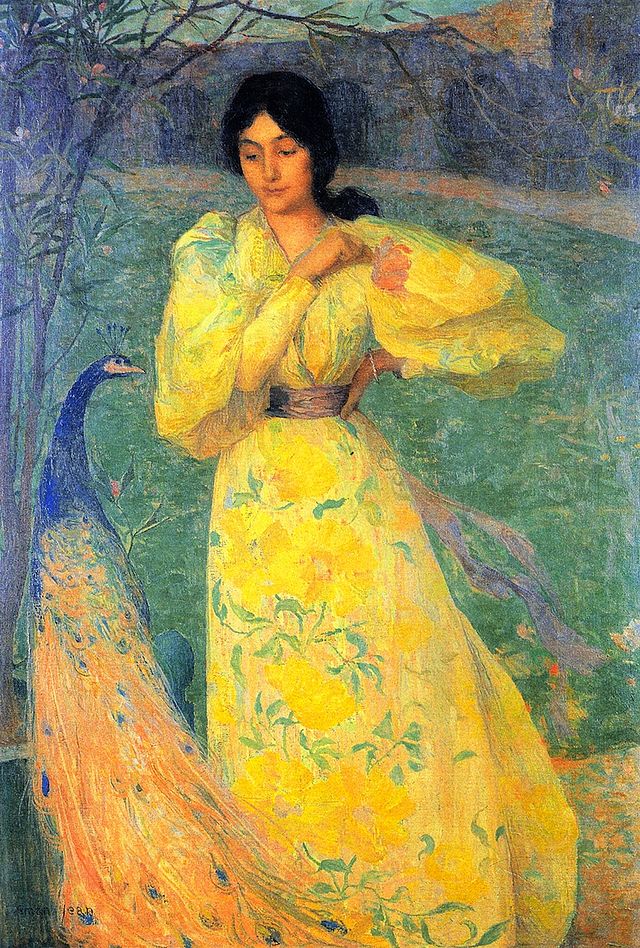
A Bird is Singing
Un oiseau chante
Guillaume Apollinaire (1880-1918)
Un oiseau chante
Un oiseau chante ne sais où
C’est je crois ton âme qui veille
Parmi tous les soldats d’un sou
Et l’oiseau charme mon oreille
Écoute il chante tendrement
Je ne sais pas sur quelle branche
Et partout il va me charmant
Nuit et jour semaine et Dimanche
Mais que dire de cet oiseau
Que dire des métamorphoses
De l’âme en chant dans l’arbrisseau
Du cœur en ciel du ciel en roses
L’oiseau des soldats c’est l’amour
Et mon amour c’est une fille
La rose est moins parfaite et pour
Moi seul l’oiseau bleu s’égosille
Oiseau bleu comme le cœur bleu
De mon amour au cœur céleste
Ton chant si doux répète-le
À la mitrailleuse funeste
Qui claque à l’horizon et puis
Sont-ce les astres que l’on sème
Ainsi vont les jours et les nuits
Amour bleu comme est le cœur même
A Bird is Singing
A bird is singing don’t know where
must be your soul that’s watchful there
among so many really mere
soldiers, his song delights my ear
Listen he sings so tenderly
where on what branch I cannot say
goes everywhere delighting me
weekdays and Sundays night and day
About this bird what can I say
about these metamorphoses
a soul on song in shrubby tree
a heart in heaven a heaven in roses
Love is the bird of soldiers. I’ve
a darling girl who is my love
more perfect than a rose of course
blue bird sings just for me he’s hoarse
Blue bird as blue as my love’s blue
heart loving heart of heaven’s own
your song is sweet recite it to
the deadly automatic gun
That clatters on the skyline do
we see the stardust being sown
the days and nights are going gone
blue love blue as the heart is blue
Translation: Copyright © Timothy Adès
More poems by Guillaume Apollinaire...
Marie
Marie
Guillaume Apollinaire (1880-1918)
Marie
Vous y dansiez petite fille
Y danserez-vous mère-grand
C’est la maclotte qui sautille
Toute les cloches sonneront
Quand donc reviendrez-vous Marie
Les masques sont silencieux
Et la musique est si lointaine
Qu’elle semble venir des cieux
Oui je veux vous aimer mais vous aimer à peine
Et mon mal est délicieux
Les brebis s’en vont dans la neige
Flocons de laine et ceux d’argent
Des soldats passent et que n’ai-je
Un cœur à moi ce cœur changeant
Changeant et puis encor que sais-je
Sais-je où s’en iront tes cheveux
Crépus comme mer qui moutonne
Sais-je où s’en iront tes cheveux
Et tes mains feuilles de l'automne
Que jonchent aussi nos aveux
Je passais au bord de la Seine
Un livre ancien sous le bras
Le fleuve est pareil à ma peine
Il s’écoule et ne tarit pas
Quand donc finira la semaine
Marie
There you danced when you were young
Will or not when you're a granny
It's the hip-hop-hootenanny
Bells will one and all be rung
When will you return, my honey?
All the masks are mute and hushed
So far off the melodies
Might be coming from the skies
Want to love you love you only just
O my pain the ecstasies
Sheep that vanish in the snow
Flakes of wool bright coinage too
Soldiers on a mission go
Here's my heart not trusty true
Changeable what might I know
Know the future of your hair
Frizzed as when the ocean heaves
Know the future of your hair
And your hands those autumn leaves
Yes our vows fall thickly there
I was strolling by the Seine
Antique book beside the river
River not unlike my pain
Won't run dry it flows for ever
Will this week at last be over
Translation: Copyright © Timothy Adès
More poems by Guillaume Apollinaire...
The Suicide
Le suicidé
Guillaume Apollinaire (1880-1918)
Le suicidé
Trois grands lys Trois grands lys sur ma tombe sans croix
Trois grands lys poudrés d’or que le vent effarouche
Arrosés seulement quand un ciel noir les douche
Majestueux et beaux comme sceptres des rois
L’un sort de ma plaie et quand un rayon le touche
Il se dresse sanglant c’est le lys des effrois
Trois grands lys Trois grands lys sur ma tombe sans croix
Trois grands lys poudrés d’or que le vent effarouche
L’autre sort de mon cœur qui souffre sur la couche
Où le rongent les vers L’autre sort de ma bouche
Sur ma tombe écartée ils se dressent tous trois
Tout seuls tout seuls et maudits comme moi je crois
Trois grands lys Trois grands lys sur ma tombe sans croix
The Suicide
No cross on my grave Three great lily flowers,
Lilies dusted with gold in the shock of the winds
Majestic and lovely as sceptres of kings
What waters them? Only the black sky’s showers
One’s the lily of terror all bloody it springs
From my wound when the touch of a sunbeam empowers
No cross on my grave Three great lily flowers,
Lilies dusted with gold in the shock of the winds
Where the worms eat my heart there’s a lily that springs
From its cradle of sorrows and sufferings
From my lips there’s a third by my creed there’s no cross
Nothing else and like me they are under a curse
No cross on my grave Three great lily flowers
Translation: Copyright © Timothy Adès
More poems by Guillaume Apollinaire...
The Last Fairy Tale
Τὸ Στερνὸ Παραμύθι
Lambros Porphyras (1879-1932)
Τὸ Στερνὸ Παραμύθι
Πήραν στρατί στρατί τό μονοπάτι
βασιλοπούλες καί καλοκυράδες,
από τίς ξένες χώρες βασιλιάδες
καί καβαλάρηδες απάνω στ’ άτι.
Καί γύρω στής γιαγιάς μου τό κρεβάτι,
ανάμεσ’ από δυό χλωμές λαμπάδες,
περνούσανε καί σάν τραγουδιστάδες
τής τραγουδούσαν – ποιός τό ξέρει; - κάτι.
Κανείς γιά τής γιαγιάς μου τήν αγάπη
δέ σκότωσε τό Δράκο ή τόν Αράπη,
καί νά τής φέρη αθάνατο νερό.
Η μάνα μου είχε γονατίσει κάτου·
μ’ απάνω – μιά φορά κι έναν καιρό –
ο Αρχάγγελος χτυπούσε τά φτερά του.
The Last Fairy Tale
Along the pathway slowly, slowly,
they came, princesses, mermaids, riders
on horses, kings of far-off countries;
moved round my granny’s bed and chanted,
between a pair of pallid tapers,
as singers do, some song or other.
Not one there was who loved my granny
and killed the dragon and the ogre
to bring her the immortal water.
Below, I saw my mother kneeling;
and, once upon a time, above us,
the Archangelic wings were beating.
Translation: Copyright © Timothy Adès
More poems by Lambros Porphyras...
The Voyage
Το Ταξίδι
Lambros Porphyras (1879-1932)
Το Ταξίδι
Όνειρο απίστευτο η λιόχαρη μέρα! Κι εγώ κι η Αννούλα
λίγοι παλιοί σύντροφοί μου καί κάποιες κοπέλες μαζί,
μπήκαμε μέσα σέ μιά γαλανή, μεθυσμένη βαρκούλα,
μπήκαμε μέσα καί πάμε μακριά στής Χαράς τό νησί.
Ούτ’ ένα σύννεφο κι ούτ’ ένας μαύρος καπνός στόν αγέρα·
πλάι μας στήθη ερωτιάρικα κι άσπροι χιονάτοι λαιμοί,
φώς στά μαλλιά τά ξανθά, φώς στό πέλαγο, φώς πέρ’ ως πέρα·
μά ποιός επήγε ποτέ του μακριά στής Χαράς τό νησί;
Ώ! τί με νοιάζει κι άν πάμε ως εκεί; τί με νοιάζει; Γελάει
όλ’ η γλυκιά συντροφιά μου, γελά η θλιμμένη ζωή,
στ’ άπειρο μέσα κυλάμε· κι η Αννούλα τρελλά τραγουδάει·
όπου καί νά ’ναι μακριά θά φανή τής Χαράς τό νησί…
The Voyage
A sun-flooded day, an incredible dream! with Annoula:
a few good old friends and some girls and Annoula and I
got into a blue, drunken boat, methysméni varkoúla,
got in and went off and away to the Island of Joy.
Not a cloud and not even a puff of black smoke in the sky:
all around us were breasts full of love, there were throats snowy-white:
there was light on fair hair, on the sea: light was everywhere, light:
oh, but who ever got there at all, to the Island of Joy?
Oh, what do I care if we get there? Who cares? In the ringing
sweet laughter of friends, all life’s troubles go laughing away!
We are rolled in infinity! Hark at Annoula’s wild singing!
Looming somewhere, wherever, the faraway Island of Joy.
Translation: Copyright © Timothy Adès
More poems by Lambros Porphyras...
Sea Voices (Stand Death a Drink)
Φωνὲς τῆς Θάλασσας
Lambros Porphyras (1879-1932)
Φωνὲς τῆς Θάλασσας
Πιέ στού γιαλού τή σκοτεινή ταβέρνα τό κρασί σου,
σέ μι’ άκρη, τώρα π’ άρχισαν ξανά τά πρωτοβρόχια,
πιέ το μέ ναύτες καί σκυφτούς ψαράδες αντικρύ σου,
μ’ ανθρώπους πού βασάνισε κι η θάλασσα κι η φτώχεια.
Πιέ το, η ψυχή σου αξένοιαστη τόσο πολύ νά γίνη,
πού άν έρθ’ η Μοίρα σου η κακιά νά τής χαμογελάσης,
καημοί καινούργιοι άν έρθουνε, μαζί σου άς πιούν κι εκείνοι,
κι άν έρθη ο Χάρος, ήσυχα κι αυτόν νά τόν κεράσης.
Sea Voices (Stand Death a Drink)
Drink in the dark tavern ashore, in the corner:
the first rains of autumn, returning, fall free.
Drink facing the crewmen, the men hunched from fishing,
men battered and tortured by hardship and sea.
Drink, make the heart carefree. If evil Misfortune
should walk through the door, smile and let the crone pass;
if new troubles come, let them join in your drinking;
come Death, you may peaceably fill up his glass.
Translation: Copyright © Timothy Adès
More poems by Lambros Porphyras...
The Bohemian Raises his Glass
Pezoa was Municipal Secretary of the Chilean town of Viña del Mar – Vineyard-on-Sea.
Carlos Pezoa Véliz (1879-1908)
Pezoa was Municipal Secretary of the Chilean town of Viña del Mar – Vineyard-on-Sea.
No escupáis a los beodos que perecen
aturdiendo en el vino sus dolores;
si odiáis a la embriaguez, odiad las flores
que ebrias de sol en la mañana crecen.
Los ojos de las vÌrgenes ofrecen
la sublime embriaguez de los amores,
y los besos son báquicos licores
al caer en los labios, estremecen.
Embriagada de luz, Ofelia vaga
en las sombras de un campo desolado;
el sacerdote en el altar se embriaga
con la sangre de Dios crucificado,
y el poeta mirando de hito en hito
la gran pupila azul del infinito!
The Bohemian Raises his Glass
Don’t look down on the drunkards who perish
befuddling their sorrows with wine:
you don’t hate the flowers that flourish
light-headed in morning sunshine.
The eyes of the ladies attract us
to the high drunken rapture of passion;
their kisses are Bacchus’s nectars -
our lips are in thrall to sensation.
Drunk with light goes Ophelia, sunken
In the gloom of a desolate plain;
The priest at the altar is drunken
With the blood of a god that is slain,
Like the poet who gazes unblinking
At the boundless blue eye of the main!
Translation: Copyright © Timothy Adès
More poems by Carlos Pezoa Véliz...
Kind und Pfau
Girl And Peacock
Erich Mühsam (1878-1934)
Girl And Peacock
Im Mäntelchen mit viel Besatz
und seidener Kapotte,
im Spitzenkragen und Seidenlatz,
so steht hier die Charlotte.
Da kommt daher ein stolzer Pfau,
mit Federn, vielen hundert,
der sieht die kleine Menschenfrau, -
und beide steh'n verwundert.
Die Lotte beugt sich staunend vor,
der Pfau beugt sich zurücke
und spreizt den blauen Federflor; -
so kreuzen sich die Blicke.
"Was ist das für ein schönes Tier!"
so denken alle beide.
Er deucht ihr ganz von Golde schier,
sie deucht ihm ganz von Seide.
- Sie seh'n sich fast die Augen blind
am Kleid und an den Daunen -
und wenn sie nicht gegangen sind,
steh'n sie wohl noch und staunen.
Kind und Pfau
In pretty coat with silken hood
and braids and trimmings fancy
and pointed collar, there she stood,
the small, silk-swaddled Nancy.
A splendid peacock chanced to pass
with feathers, several hundred,
and saw the little human lass.
Both stood and gaped, and wondered:
Nancy leant forward in surprise,
the lovely bird leant backward:
the two could not believe their eyes!
Their postures were quite awkward.
He spread his azure feather-fan.
Reciprocally gazing,
each marvelled: What’s this creature, then!
How lovely, how amazing!
He thought: She’s silk! She thought: He’s gold!
The garb, the plumes perceiving,
it’s possible they’re still on hold,
immobile, disbelieving!
Translation: Copyright © Timothy Adès
More poems by Erich Mühsam...
Big Pond Quinsy
Sea Fever
John Masefield (1878-1967)
Sea Fever
Let's see whether he needed the letter E.
I must go down to the seas again, to the lonely sea and the sky,
And all I ask is a tall ship and a star to steer her by,
And the wheel's kick and the wind's song and the white sail's shaking,
And a grey mist on the sea's face, and a grey dawn breaking.
I must go down to the seas again, for the call of the running tide
Is a wild call and a clear call that may not be denied;
And all I ask is a windy day with the white clouds flying,
And the flung spray and the blown spume, and the sea-gulls crying.
I must go down to the seas again, to the vagrant gypsy life,
To the gull's way and the whale's way, where the wind's like a whetted knife;
And all I ask is a merry yarn from a laughing fellow-rover,
And quiet sleep and a sweet dream when the long trick's over.
Big Pond Quinsy
I must go down and all I ask
is a tall ship and a star
I must go back to what’s briny, just big sky and a briny splat,
And all I ask is a tall ship and a star to point it at,
A hub swinging round, a wind-humming sound, and a snowy sailcloth shaking,
A briny phiz that’s hazily gray, and a gray dawn waking.
I must go back to what’s briny, for that calling of flux and flow
Is a wild call and a loud call, to which you don’t say no;
And all I ask is a windy day with cotton-wool clouds flying,
With flung spray and with blown foam, and gulls and fulmars crying.
I must go back to what’s briny, now! to my vagrant gypsy way, sir,
To a gull’s way and an orca’s way, and a wind as sharp as a razor;
And all I ask is a jolly yarn from a laughing amigo-in-roving,
And a tranquil nap with visions of pap, as my shiftwork clock stops moving.
Translation: Copyright © Timothy Adès
More poems by John Masefield...
I will go high up
Ich will alleine...
Erich Mühsam (1878-1934)
Ich will alleine...
Ich will alleine über die Berge gehn,
und keiner soll von meinen Wegen wissen;
denn wer den Pfad zu meinen Höhn gesehn,
hat mich von meinen Höhn herabgerissen.
Ich will alleine über die Berge gehn,
mein Lied soll ungehört am Fels verklingen,
und meine Klage soll im Wind verwehn; –
nur wer dem eignen Herzen singt, kann singen; –
nur wer dem eigenen Herzen klagt, kann klagen;
nur wer das eigne Herz erkennt, kann sehn. –
Hinauf zu mir! Ich will der Welt entsagen,
und will alleine über die Berge gehn.
I will go high up
I will go high up among the hills, alone,
And there is nobody who shall know my ways.
All who have seen the path to my lofty place,
They from my prominences have torn me down.
I will go high up among the hills, alone.
My song shall fade on the crag, none listening,
And lost on the wind shall be my piteous groan:
Only you who sing to your very own heart can sing.
Only you who groan to your very own heart can groan.
Only you who know your very own heart can see.
Come join me, I turn from the world’s malignity,
I will go high up among the hills, alone.
Translation: Copyright © Timothy Adès
More poems by Erich Mühsam...