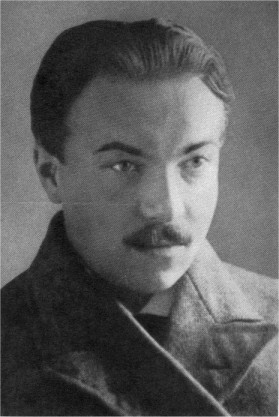
In Your Room
In deinem Zimmer
Ernst Wilhelm Lotz (1890-1914)
In deinem Zimmer
In deinem Zimmer fand ich meine Stätte.
In deinem Zimmer weiß ich, wer ich bin.
Ich liege tagelang in deinem Bette
Und schmiege meinen Körper an dich hin.
Ich fühle Tage wechseln und Kalender
Am Laken, das uns frisch bereitet liegt.
Ich staune manchmal still am Bettgeländer,
Wie himmlisch lachend man die Zeit besiegt.
Bisweilen steigt aus fernen Straßen unten
Ein Ton zu unserm Federwolkenraum,
Den schlingen wir verschlafen in die bunten
Gobelins, gewirkt aus Küssen, Liebe, Traum.
In Your Room
It’s in your room I’ve found the place I live in,
It’s here I know just what I am, and who.
I’m in your bed from morning through to evening,
And snuggle up my body close to you.
I sense, each time our sheets are freshly laundered,
The passing weeks, the seasons of the year.
And by the handrail of the bed I’ve wondered
At how we conquer Time with our good cheer.
Sometimes a sound from streets below comes climbing
Up to our feather-cloud-world, high above:
We oversleep and thread it in our cheerful
Gobelins, wrought of kisses, dreams, and love.
Translation: Copyright © Timothy Adès
More poems by Ernst Wilhelm Lotz...
Breakfast
Frühstück
Kurt Tucholsky (1890-1935)
Frühstück
Stell auf den Tisch das braune Kaffeekännchen
und rück mir näher, dickes Ännchen!
Die Sonne scheint, die Vöglein pfeifen,
man kann dich mollig in die Backen kneifen.
Wie schmeckt das Frühstück Mund an Munde!
Dies ist des Tages schönste Stunde.
Breakfast
Put the brown coffee-pot on the table,
Annie Fatty-pot! The sun is warm,
Birds are in form, come here and inch
Nearer to me so I’ll be able
To give your chubby cheeks a pinch.
Tasty brekker, mouths together:
All day long, nothing’s better.
Translation: Copyright © Timothy Adès
More poems by Kurt Tucholsky...
Paragraph 218
Paragraph 218
Erich Weinert (1890-1953)
Paragraph 218
So lebt das alte Scheusal immer noch
Im Pfaffendunkel und Gesetzekälte?
Das grinsend über Liebesträume kroch
Mit Leichenfingern frommer Staatsanwälte.
So dient ein Weib, das noch was auf sich hält
Teils der Moral und teils dem Nationalen.
Wer wahrhaft christlich ist, der braucht kein Geld;
Der Himmel wird die Alimente zahlen.
Jawohl es lebt als sittliches Prinzip,
Besonders für die niedren Atmosphären.
Ein deutsches Weib hat nur den einen Trieb,
So viel als möglich Kinder zu gebären.
Denn einmal braucht man Menschenmaterial
Für Unternehmer und für kunftge Schlachten,
Und zweitens auch im Hinblick der Moral
Muß jedes Weib nach vielen Kindern trachten.
Ein jeder Tag zeigt uns erneut:
Entsittlichung herrscht nur in untern Schichten,
In daß die bessern Stände jederzeit
Sich streng nach jenen Paragraphen richten.
Deshalb vermehret Euch mit Gottvertrauen,
Ihr Proletarier und ihr Angestellten!
Nehmt Euch ein Vorbild an den echten Frauen
Von Sittlichkeitsdurchtränkten Staatsanwälten!
Paragraph 218
In the dark of the Church and the chill of the Law
Is the monster of old yet lurking,
With a priggish attorney’s cadaverous claw
To crawl on Love’s dream, still smirking?
A good woman serves with confidence
Morality, yes, and the Nation.
Her support is paid for by Providence:
That’s enough for the genuine Christian.
Here’s a moral precept that still survives,
Meant first for the humblest, maybe:
A true German woman has no other drives,
She’s always having a baby.
Our human stocks are our vital resource,
For employers and (one day) for battle;
And all women have their duty of course,
Which is unremittingly natal.
We see it afresh every single day,
Moral rot in the lower divisions:
The superior elements, come what may,
Stay strictly within the provisions.
So trust in the Lord, lowly workers and clerks,
And breed like the mice in your houses.
Think of Crown briefs, stewed in their rectitude:
Take after their stainless spouses.
Translation: Copyright © Timothy Adès
More poems by Erich Weinert...
Poor Wife!
Die arme Frau
Kurt Tucholsky (1890-1935)
Die arme Frau
Mein Mann? Mein dicker Mann, der Dichter?
Du lieber Gott, da seid mir still!
Ein Don Juan? Ein braver, schlichter
Bourgeois – wie Gott ihn haben will.
Da steht in seinen schmalen Büchern,
wie viele Frauen er geküßt;
von seidenen Haaren, seidenen Tüchern,
Begehren, Kitzel, Brunst, Gelüst..
.
Liebwerte Schwestern, laßt die Briefe,
den anonymen Veilchenstrauß!
Es könnt ihn stören, wenn er schliefe.
Denn meist ruht sich der Dicke aus.
Und faul und fett und so gefräßig
ist er und immer indigniert.
Und dabei gluckert er unmäßig
vom Rotwein, den er temperiert.
Ich sah euch wilder und erpichter
von Tag zu Tag – ach! laßt das sein!
Mein Mann? Mein dicker Mann, der Dichter?
In Büchern: ja. Im Leben: nein
Poor Wife!
My big fat poet, my old man?
Lord! Don’t keep on at me.
A nice thin bourgeois, a Don Juan?
So God would have him be.
You’ve read it in his slender books,
How many women kissed,
The silken stuffs, the silken locks,
Hopes, gropes, hot passion, lust…
Dear sisters, let the love-notes go,
Those hinting violets:
You might disturb his sleep, you know,
Yes, all that sleep he gets!
He’s fat, he’s lazy, gluttonous,
He drinks red wine - he glugs –
He is excessive, always cross -
He doctors it in jugs.
I’ve seen you get more wild and hot
Each day – forget him, please!
My big fat poet, my old man?
In books he is, in real life he’s -
He’s not.
Translation: Copyright © Timothy Adès
More poems by Kurt Tucholsky...
To Death
An den Tod
Gerrit Engelke (1890-1918)
An den Tod
Mich aber schone, Tod,
Mir dampft noch Jugend blutstromrot, –
Noch hab ich nicht mein Werk erfüllt,
Noch ist die Zukunft dunstverhüllt –
Drum schone mich, Tod.
Wenn später einst, Tod,
Mein Leben verlebt ist, verloht
Ins Werk – wenn das müde Herz sich neigt,
Wenn die Welt mir schweigt, –
Dann trage mich fort, Tod.
To Death
But spare me, Death,
Still young and warm is my blood’s breath,
My work not yet fulfilled,
The future darkly veiled,
Then spare me, Death.
If later, Death,
My life is done and finished with,
Burnt into work – brought low the weary heart,
If the world, wordless, plays no part, –
Then take me, Death.
Translation: Copyright © Timothy Adès
More poems by Gerrit Engelke...
Figura de México / Outline of Mexico
Alfonso Reyes (1889-1959)
La verdad no padece porque la digan muchos,
y es suerte que a los lerdos persuada y a los duchos.
Nadie ignora que México vuelca su cornucopia —
— irónica figura, naturaleza propia —
sobre las ensanchadas tierras del Septentrión,
para mejor servirlas con su contribución.
Pero hay otros misterios en su geografía
que, por ventura nuestra, se aclaran cada día.
Con el sajón arriba, con el latino abajo,
hace de centinela, aunque no sin trabajo.
¡Y ojalá que concilie desigualdad tamaña
que todo lo confunde y todo lo enmaraña!
Paso de los efluvios entre uno y otro mar,
de Oriente y de Occidente solicitado al par,
tiende su masa oblicua por los contrarios puntos
y alarga sendos brazos para enlazarlos juntos.
¡Puedan Europa y Asia ceder al mismo imán
por Baja California o bien por Yucatán!
Tal es el jeroglifo que esconde la figura,
que confirma la historia, que ostenta la escritura
en esa persistente equis de los destinos
estrella de los rumbos, cruce de los caminos.
Si tiene algún sentido la cara del planeta,
el sabio lo interrogue y suéñelo el poeta.
Figura de México / Outline of Mexico
Truth’s told and checked and balanced, to which there’s no objection:
The talented, the challenged, both profit from instruction.
Mexico’s curved and conic, pours out its cornucopia
— The outline is ironic, the instinct’s true and proper —
On swelling lands expanded beyond the Rio Grande,
To serve our neighbours better with bounteous open hand.
We teem with geographic peculiarities,
And every day that passes sheds further light on these.
The Saxon is above us, the Latin is below:
No sinecure, they have us on constant sentry–go.
And look at the anomalies that here are reconciled:
A land of joins and jumbles, where everything’s embroiled!
Where passing clouds are wafted from sea to shining sea,
By Occident accosted and Orient equally,
It spreads its mass obliquely from point to counterpoint,
And sends out arms respective, embracing both conjoint.
All Europe and all Asia yield spellbound to the plan,
Through Baja California and through the Yucatan.
Such is the hieroglyphic this outline files away,
And history can confirm it, and literature display.
This is the X of Schicksal, the stubborn, fateful X,
Star–compass of the fo’c’sle, criss–crossing of the tracks!
The portrait of the planet has rhyme and reason to it:
The scientist can scan it; to dream it takes the poet.
Translation: Copyright © Timothy Adès
More poems by Alfonso Reyes...
Silence
Silencio
Alfonso Reyes (1889-1959)
Silencio
Escojo la voz más tenue
para maldecir del trueno,
como la miel más delgada
para triaca del veneno.
En la corola embriagada
del más’efímero sueño,
interrogo las astucias
del desquite contra el tiempo,
y a la barahunda opongo
el escogido silencio.
No es menos luz la centella
por cegar sólo un momento,
ni es desamor el amor
que enmudece por intenso.
Cada vez menos palabras;
y cada palabra, un verso;
cada poema, un latido;
cada latido, universo.
Esfera ya reducida
a la norma de su centro,
es inmortal el instante
y lo fugitivo eterno.
Flecha que clavó el destino,
aunque presuma de vuelo,
déjate dormir, canción,
que ya duraste un exceso.
Silence
This voice is most slender,
my choice to curse thunder,
as honey most tender
is physic for venom.
In a bud that is primed
on ephemeral dream,
I inquire into ploys
to get even with time;
I counter the noise
with silence, my choice.
No less Light is the spark
that is dark for a moment
and love is still love
by intensity silent.
Each time, fewer words;
and each word, a verse;
each poem, a pulse;
each pulse, universe.
A sphere now reduced
to the span of its kernel,
the moment’s immortal,
the fleeting’s eternal.
So sleep now, my song,
you’re a dart that fate nailed,
whose flight–plan has failed;
you’ve lasted too long.
Translation: Copyright © Timothy Adès
More poems by Alfonso Reyes...
To Wine
Poema Al Vino
Jorge Luis Borges (1889-1986)
Poema Al Vino
En el bronce de Homero resplandece tu nombre,
negro vino que alegras el corazón del hombre.
Siglos de siglos hace que vas de mano en mano
desde el ritón del griego al cuerno del germano.
En la aurora ya estabas. A las generaciones
les diste en el camino tu fuego y tus leones.
Junto a aquel otro río de noches y de días
corre el tuyo que aclaman amigos y alegrías.
Vino que como un Éufrates patriarcal y profundo
vas fluyendo a lo largo de la historia del mundo.
En tu cristal que vive nuestros ojos han visto
una roja metáfora de la sangre de Cristo.
En las arrebatadas estrofas del sufí
eres la cimitarra, la rosa y el rubí.
Que otros en tu Leteo beban un triste olvido;
yo busco en ti las fiestas del fervor compartido.
Sésamo con el cual antiguas noches abro
y en la dura tiniebla, dádiva y candelabro.
Vino del mutuo amor o la roja pelea,
alguna vez te llamaré. Que así sea.
To Wine
In Homer’s bronze resplendence, your name was seen to shine,
you who make glad the heart of man, you dark mysterious wine.
For centuries on centuries you’ve passed from hand to hand,
from rhyton of Achaean to horn of Allemand:
for you were there when morning broke: you gave the passing years,
the mortal generations, your valour and your fires.
Joined to that other river that flows through nights and days,
your own runs on, by friends acclaimed, and songs of joyful praise:
wine like a great Euphrates patriarchal and profound,
your ample current courses through the story of mankind.
Within your living crystal these eyes of ours have seen
a crimson metaphor, the blood of Christ the Nazarene.
In the impassioned Rubaiyát, the quatrains of the seer,
you are the ruby and the rose, you are the scimitar.
Let others drink oblivion’s draught, Lethean misery,
I’ll seek in you the fervour of shared festivity.
A sesame that opens my immemorial night,
against oppressive darkness, a gift of candlelight:
wine of reciprocated love, or blood-red enmity,
some day I’ll call upon you. So be it: let it be.
Translation: Copyright © Timothy Adès
More poems by Jorge Luis Borges...
Sonnet to Wine
Soneto al Vino
Jorge Luis Borges (1889-1986)
Soneto al Vino
¿En qué reino, en qué siglo, bajo qué silenciosa
conjunción de los astros, en qué secreto día
que el mármol no ha salvado, surgió la valerosa
y singular idea de inventar la alegría?
Con otoños de oro la inventaron. El vino
fluye rojo a lo largo de las generaciones
como el río del tiempo y en el arduo camino
nos prodiga su música, su fuego y sus leones.
En la noche del júbilo o en la jornada adversa
exalta la alegría o mitiga el espanto
y el ditirambo nuevo que este día le canto.
Otrora lo cantaron el árabe y el persa.
Vino, enséñame el arte de ver mi propia historia
como si ésta ya fuera ceniza en la memoria.
Sonnet to Wine
What realm was it, what century? What silent stars concurred?
Which was the secret day, the day no marble could record:
birth of the intuition, tremendous and unheard,
that joy might be invented, and ecstasy assured?
From autumn’s gold they fashioned it; and like the stream of days,
down through the generations the red wine carves its ways,
regales us with its music, its lions and its blaze.
Be it the night of triumph, be it the fatal day,
wine raises high our happiness, it soothes our fears away:
and here’s a brand-new dithyramb I sing for it today.
The Arab and the Persian, they sang its praise of old.
Wine, teach me all my history, that I may see it told
as if it were the memory of ashes dead and cold!
Translation: Copyright © Timothy Adès
More poems by Jorge Luis Borges...
Grandfather
El Abuelo
Alfonso Reyes (1889-1959)
El Abuelo
– Dínos, viejo galán de
la edad florida:
de todas tus nietas
la preferida?
– Una lleva el nardo,
¡y es tan altiva!
Mortecina en la luz,
y en la sombra, viva.
– Dínos, viejo galán de
la edad florida:
de tus netezuelas
¿la preferida?
– Otra lleva la rosa,
¡y es tan gallarda!
Fácil es a la risa,
y al lloro, tarda.
– Dínos, viejo galán de
la edad florida:
de tus nietas todas
¿la preferida?
– Otra lleva el jazmín, tan
pequeñito!
Pero fresco aroma,
gozoso el grito.
Prósperos climas son,
benéficos cielos,
donde ya los hijos
nos hacen abuelos.
–¡Ay, abuelo galán!
¡Unos amores vienen
y otros se van!
–¡Ay, quién vio la primera
uva que brotaba
de tu majuelo!
– ¡Ay, que la primavera
no se me acaba,
aun siendo abuelo!
Grandfather
Tell us, old gallant of
season in flower,
which of your grand-daughters
do you prefer?
– One bears the spikenard
she is so proud
pale in the sunlight
glowing in cloud.
– Tell us, old gallant of
season in flower,
which little grand-daughter
do you prefer?
– One bears the rose and
she’s full of joy
her laughter’s easy
she’s slow to cry.
– Tell us, old gallant of
season in flower,
which of your grand-daughters
do you prefer?
– One bears the jasmine
small as can be:
fresh is the fragrance,
loud is her glee.
Friendly the skies, fair
all winds and weathers,
when our sons make us
into grandfathers.
– Good old grandfather!
loves come and go
your vine’s first harvest
you saw it grow.
– I have my springtime
though a grandfather:
springtime for ever!
Translation: Copyright © Timothy Adès
More poems by Alfonso Reyes...