The Drowned Girl

Vom ertrunkenen Mädchen

Bertolt Brecht (1898-1956)

Vom ertrunkenen Mädchen
Als sie ertrunken war und hinunterschwamm Von den Bächen in die großeren Flüsse Schien der Opal des Himmels sehr wundersam Als ob er die Leiche begütigen müsse. Tang und Algen hielten sich an ihr ein So daß sie langsam viel schwerer ward. Kühl die Fische schwammen an ihrem Bein Pflanzen und Tiere beschwerten noch ihre letzte Fahrt. Und der Himmel ward abends dunkel wie Rauch Und hielt nachts mit den Sternen das Licht in Schwebe. Aber früh ward er hell, daß es auch Noch für sie Morgen und Abend gebe. Als ihr bleicher Leib im Wasser verfaulet war Geschah es (sehr langsam), daß Gott sie allmählich vergaß Erst ihr Gesicht, dann die Hände und ganz zuletzt erst ihr Haar. Dann ward sie Aas in Flüssen mit vielem Aas.
The Drowned Girl
When she was drowned she floated on and on Down the streams and brooks and into the great big river The opal light of heaven most splendidly shone As if impelled to do the body a favour. Grappled and held by the water-weeds and the slimes, Slowly and out of proportion her weight increased. Fishes swam coolly along beside her limbs. Last haul! as a ferry for green-stuff and water-beast. In the evenings the sky was as dark as smoke With the stars by night it kept the light in play But the brightness came on early when morning broke So she still had the start and the finish of the day. As her pallid corpse lay foul in the water there By God himself she was little by little forgotten: First her face, then her hands, then finally her hair. She was just more meat in the water, decayed and rotten. Published in Agenda 2014, vol. 48/2
A selection from YouTube...

Translation: Copyright © Timothy Adès
More poems by Bertolt Brecht...

The Four Mule-Drivers

Los cuatro muleros

Federico García Lorca (1898-1936)

Los cuatro muleros
De los cuatro muleros que van al campo, el de la mula torda, moreno y alto. De los cuatro muleros que van al agua, el de la mula torda me roba el alma. De los cuatro muleros que van al río, el de la mula torda es mi marío. ¿A qué buscas la lumbre la calle arriba, si de tu cara sale la brasa viva?
The Four Mule-Drivers
One of the four mule-drivers gone to the water, one with the dappled jenny is tall and swarthy. One of the four mule-drivers gone to the greenwood, one with the dappled jenny, my soul he plundered. One of the four mule-drivers gone to the grassland, one with the dappled jenny, he is my husband. Why do you seek the lamplight where streets go turning, if from your very features the coals are burning?

Translation: Copyright © Timothy Adès
More poems by Federico García Lorca...

Lovers

Die Liebenden

Bertolt Brecht (1898-1956)

Die Liebenden
Sieh jene Kraniche in großem Bogen! Die Wolken, welche ihnen beigegeben Zogen mit ihnen schon, als sie entflogen Aus einem Leben in ein andres Leben In gleicher Höhe und mit gleicher Eile Scheinen sie alle beide nur daneben. Daß so der Kranich mit der Wolke teile Den schönen Himmel, den sie kurz befliegen Daß also keines länger hier verweile Und keines andres sehe als das Wiegen Des andern in dem Wind, den beide spüren Die jetzt im Fluge beieinander liegen So mag der Wind sie in das Nichts entführen Wenn sie nur nicht vergehen und sich bleiben Solange kann sie beide nichts berühren Solange kann man sie von jedem Ort vertreiben Wo Regen drohen oder Schüsse schallen. So unter Sonn und Monds wenig verschiedenen Scheiben Fliegen sie hin, einander ganz verfallen. Wohin ihr? Nirgendhin. Von wem davon; Von allen. Ihr fragt, wie lange sind sie schon beisammen? Seit kurzem. Und wann werden sie sich trennen? Bald. So scheint die Liebe Liebenden ein Halt.
Lovers
See that great arc of cranes! The clouds, their own companions, Went with them as they flew From one life to another: Same height, same speed, the two Seemed to glide on together. So crane and cloud, who share The glorious sky, go quickly by, And neither lingers here, but sees Only the other ride the breeze, Both alongside and both aware; The wind cajoles them to the void. If they survive, stay close-deployed, Nothing can harm the clouds and cranes, Not crash of guns nor threat of rains. Beneath the discs of moon and sun, Wrapped in each other, they fly on. Where from? From nowhere. Where to? Everywhere. You ask: And how long have they been a pair? Not long. How soon to part? The time is short. Lovers imagine love’s a sure support.
Said at Chichester 2023

Translation: Copyright © Timothy Adès

More poems by Bertolt Brecht...

Qasida of the Rose

Casida de la rosa

Federico García Lorca (1898-1936)

Casida de la rosa
La rosa no buscaba la aurora: casi eterna en su ramo, buscaba otra cosa. La rosa, no buscaba ni ciencia ni sombra: confín de carne y sueño, buscaba otra cosa. La rosa, no buscaba la rosa. Inmóvil por el cielo buscaba otra cosa.
Qasida of the Rose
The rose sought not the new day: on its stem it shall stay, it sought none of those. The rose sought not shadow nor study: between sleep and body, it sought none of those. The rose sought not for the rose: unmoving in heaven, it sought none of those.

Translation: Copyright © Timothy Adès

More poems by Federico García Lorca...

Sir

Monsieur

Géo Norge (1898-1990)

Monsieur
Je vous dis de m’aider, Monsieur est lourd. Je vous dis de crier, Monsieur est sourd. Je vous dis d’expliquer, Monsieur est bête. Je vous dis d’embarquer, Monsieur regrette. Je vous dis de l’aimer, Monsieur est vieux. Je vous dis de prier, Monsieur est Dieu. Éteignez la lumière, Monsieur s’endort. Je vous dis de vous taire, Monsieur est mort.
Sir
You must help, Sir’s enormous. You must yelp, Deaf as a dormouse. You must explain, Sir is silly. Board the train, Sir is sorry. You must love him, Sir is old. You must pray, Sir is God. Lights out! Sir’s in bed. Silence! Sir is dead.

Translation: Copyright © Timothy Adès

More poems by Géo Norge...

Sonnet 5

Categories
French

Sonnet 5

Jean Cassou (1897-1986)

Les poètes, un jour, reviendront sur la terre. Ils reverront le lac et la grotte enchantée, les jeux d’enfants dans les bocages de Cythère, le vallon des aveux, la maison des péchés, et toutes les amies perdues dans la pensée, les sœurs plaintives et les femmes étrangères, le bonheur féerique et la douce fierté qui posait des baisers à leur front solitaire. Et ils reconnaîtront, sous des masques de folles, à travers Carnaval, dansant la farandole, leurs plus beaux vers enfin délivrés du sanglot qui les fit naître. Alors, satisfaits, dans le soir, ils s’en retourneront en bénissant la gloire, l’amour perpétuel, le vent, le sang, les flots. From 33 Sonnets Composés au Secret copyright © Éditions Gallimard 1995
Sonnet 5
The poets shall return to earth one day: the lake and magic cave again they’ll see, Cythera’s tanglewoods where children play, the house of sins, the vale of constancy, and, lost in meditation, every she, sisters of sighs, fair friends from far away, unearthly joy and sweet nobility that kissed their forehead’s loneliness away. They’ll recognise in masks maniacal, dancing the farandole in carnival, their finest verse, freed from the agony that gave it birth: and then, in happiness, as evening falls they shall depart, and bless long love and glory, wind, and blood, and sea.
Published in 33 Sonnets of the Resistance Arc Publications, 2002

Translation: Copyright © Timothy Adès

More poems by Jean Cassou...

"C"

Les Ponts de Cé

Louis Aragon (1897-1982)

The poem dates from 1942, and was set to music by Poulenc in 1943. Les Ponts de Cé, on the Loire near Angers: a strategic crossing, scene of bloody fighting in 1432, 1620 and 1940. Crossing the Loire into the ‘Free Zone’ enabled Aragon to be a Resistance fighter. Lancelot crossed the perilous Pont de l’Épée for love of Guinevere. Lay: a poem of octosyllables, with a single rhyme, much favoured in the Middle Ages, about love (often impossible) and chivalry. The chief exponent was the mysterious 'Marie de France'.
Les Ponts de Cé
J’ai traversé les ponts de Cé C’est là que tout a commencé Une chanson des temps passés Parle d’un chevalier blessé D’une rose sur la chaussée Et d’un corsage délacé Du château d’un duc insensé Et des cygnes dans les fossés De la prairie où vient danser Une éternelle fiancée Et j’ai bu comme un lait glacé Le long lai des gloires faussées La Loire emporte mes pensées Avec les voitures versés Et les armes désamorcées Et les larmes mal effacées Ô ma France ô ma délaissée J’ai traversé les ponts de Cé
"C"
I’ve crossed the Loire at Cé (that’s "C"), the start of this whole tendency. A song of ancient minstrelsy, a knight, a nasty wound has he, a rose on roads of vagrancy, and breasts bereft of decency: castle of some duke’s lunacy, swans on the ditches’ buoyancy, meadow of dancing ecstasy, a bride’s eternal constancy. I drank chilled milk, fake fantasy: false glories, long lay’s poesy. The Loire sweeps all my thoughts to sea, trucks belly-up, sad sight to see, and weapons lacking potency, a smear of tears: despondency. Dear France, forlorn expectancy! I’ve crossed the bridge at Cé, or C.
Set by Poulenc, sung by Dame Felicity Lott: https://www.youtube.com/watch?v=OII1DFCz6oU

Translation: Copyright © Timothy Adès

More poems by Louis Aragon...

ELSA YOUR EYES

LES YEUX D'ELSA

Louis Aragon (1897-1982)

LES YEUX D'ELSA
Tes yeux sont si profonds qu'en me penchant pour boire J'ai vu tous les soleils y venir se mirer S'y jeter à mourir tous les désespérés Tes yeux sont si profonds que j'y perds la mémoire À l'ombre des oiseaux c'est l'océan troublé Puis le beau temps soudain se lève et tes yeux changent L'été taille la nue au tablier des anges Le ciel n'est jamais bleu comme il l'est sur les blés Les vents chassent en vain les chagrins de l'azur Tes yeux plus clairs que lui lorsqu'une larme y luit Tes yeux rendent jaloux le ciel d'après la pluie Le verre n'est jamais si bleu qu'à sa brisure Mère des Sept douleurs ô lumière mouillée Sept glaives ont percé le prisme des couleurs Le jour est plus poignant qui point entre les pleurs L'iris troué de moire plus bleue d'être endeuillé Tes yeux dans le malheur ouvrent la double brèche Par où se reproduit le miracle des Rois Lorsque le coeur battant, ils virent tous les trois Le manteau de Marie accroché dans la crèche Une bouche suffit au mois de mai des mots Pour toutes les chansons et pour tous les hélas Trop peu d'un firmament pour des millions d'astres Il leur fallait tes yeux et leurs secrets gémeaux L'enfant accaparé par les belles images Écarquille les siens moins démesurément Quand tu fais les grands yeux je ne sais si tu mens On dirait que l'averse ouvre des fleurs sauvages Cachent-ils des éclairs dans cette lavande où Des insectes défont leurs amours violentes Je suis pris au filet des étoiles filantes Comme un marin qui meurt en mer en plein mois d'août J'ai retiré ce radium de la pechblende Et j'ai brûlé mes doigts à ce feu défendu Ô paradis cent fois retrouvé reperdu Tes yeux sont mon Pérou ma Golconde mes Indes Il advint qu'un beau soir l'univers se brisa Sur des récifs que les naufrageurs enflammèrent Moi je voyais briller au-dessus de la mer Les yeux d'Elsa les yeux d'Elsa les yeux d'Elsa
ELSA YOUR EYES
your eyes so deep I stoop to drink I’ve seen all the bright suns assemble here to preen seen the despairing all plunge in to die your eyes so deep I lose my memory in the birds’ shade it’s raging ocean tempest then see the weather’s fine your eyes are changed as summer carves clouds to apron-size for angels sky’s never bluer than above the harvest what if the winds dispel the blues of heaven your eyes outshine it when a teardrop glitters your eyes the clear skies’ envy after showers never so blue the glass as when it’s broken o the wet brightness seven-sorrowed mother the colour-prism pierced by seven broadswords the day stabs deep that stabs among the mourners the shot-silk iris bluer for the graveside your eyes in sorrow pierce the pair of holes the magi re-enact their miracle all three of them observed with pounding pulse the cloak of Mary hanging in the stall may-time of words a pair of lips suffice for all the cries of woe and all the songs not enough heaven for the starry throngs they need your eyes and their twin mysteries the child with pretty pictures on the brain reveals his own affairs more cautiously you make big eyes perhaps it means you lie exotic blooms laid open by the rain do they hide lightning in the lavenders where insects shaft their violent amours I’m tangled in the net of shooting stars a sailor dead at sea in august fires I won this radium from the raw pitchblende in this forbidden fire my fingers burned my paradise so often lost and found your eyes my indies andes demavend it happened one fine night the universe foundered on reefs where wreckers lit a flame set high above the sea I saw them gleam your eyes elsa your eyes elsa your eyes
published in Agenda

Translation: Copyright © Timothy Adès

More poems by Louis Aragon...

Mars Awestruck

MARS ÉMERVEILLÉ

Jean Cassou (1897-1986)

From the book The Madness of Amadis (Agendapoetry) - Translated by Timothy Adès
MARS ÉMERVEILLÉ
Quoi? disait ce guerrier, c’est dans mes bras, Vénus, que tombe ton destin de beauté souveraine: tes cheveux nonpareils, ta gorge, tes pieds nus et le trésor marin que tes cuisses detiennent ! Entre tant de servants du nombre universel, indiscernables chacun de chacun, pourquoi celui-ci qui ne répond: moi, qu’au seul appel de lui-même, sans doute aussi dénommé moi ? Mais, oh! l’obscure voix qui s’aventure ainsi Sous l’armure pareille aux pareilles armures, quel enfouissement de fol orgueil parmi la rigoureuse égalité des morts futurs! Choix de la foudre! Vol frémissant de la bille tremblant de prononcer son chiffre, et toi, couteau, aile d’oiseau de mer, qui sinues et scintilles sur la vaste étendue des cornes de taureaux ! Mon taureau ! Noir ou blanc, fils du sort, je t’embrasse. J’embrasse tout destin par la nuit projeté et, sur l’autel massif de mon thorax, j’enlace mon propre chef de mes deux bras de fer noués, attendant qu’à leur place, adorable mystère, apparaissent, Vénus, tes bras, fleuve de lait d’amande douce, odeur condensée de lumière, collier, bouche d’abîme et de suavité. Loin de m’y engloutir, j’y trouve ma naissance et le cercle lustral de mes fonts baptismaux. J’existe par tes cris, tes extases, tes transes et c’est pour ma saillie que tu jaillis des flots. Et toi, n’est-ce étonnant que de tant de déesses et de nymphes des bois, des prairies, des rochers, ce soit toi qui, sitôt que je dise : maîtresse, t’encoures sur mon cœur ton visage cacher? J’écarte tes cheveux, j’écarte tes paupières, je te regarde jusqu’ au fond de ton regard. Non, je ne connaîtrai jamais d’heure dernière et dans l’éternité je mets tout notre espoir.
Mars Awestruck
`What!' said the warrior, `Venus, in my arms your destiny as sovereign beauty lies. Bare feet, and throat, your hair's unrivalled charms, and the sea-treasure guarded by your thighs! Of all the whole world's interchangeable obedient servants, madam, tell me why this one, who answers `I' to one sole call: his own, and that itself is surely `I'. But, high adventure for this voice, half-heard, in this plain armour of the armoury! High pride, in strict equality interred, plunged among equals who are doomed to die. Thunder must choose! the bullet's whirring flight trembles to speak its number, and the blade, wing of a seabird, sinuously bright, thrusts through wide horns of bulls its estocade. Bull of my fate! White, black, in my embrace! I grasp the fate thrust on me by the night. On my great breastplate's altar I enlace my own head, in my two strong arms locked tight, till in their place, mysterious, marvellous, Venus, your arms appear, soft stream of milk of almonds, sweet quintessence luminous, necklace and mouth abyssal, smooth as silk. I'm not submerged, but find my birth in this, find my baptismal springs, my lustral home, exist in your cries, trances, ecstasies. To mate with me you spurted from the foam. Strange that of all those goddesses, divine nymphs of the woods, the fields, the mountain-crest, you are the one, when I say: mistress mine, who runs to hide her forehead in my breast! I brush aside your lashes and your hair, gaze deep into the chasms of your gaze. No, I shall never know a final hour: I store up all our hope in endless days.'
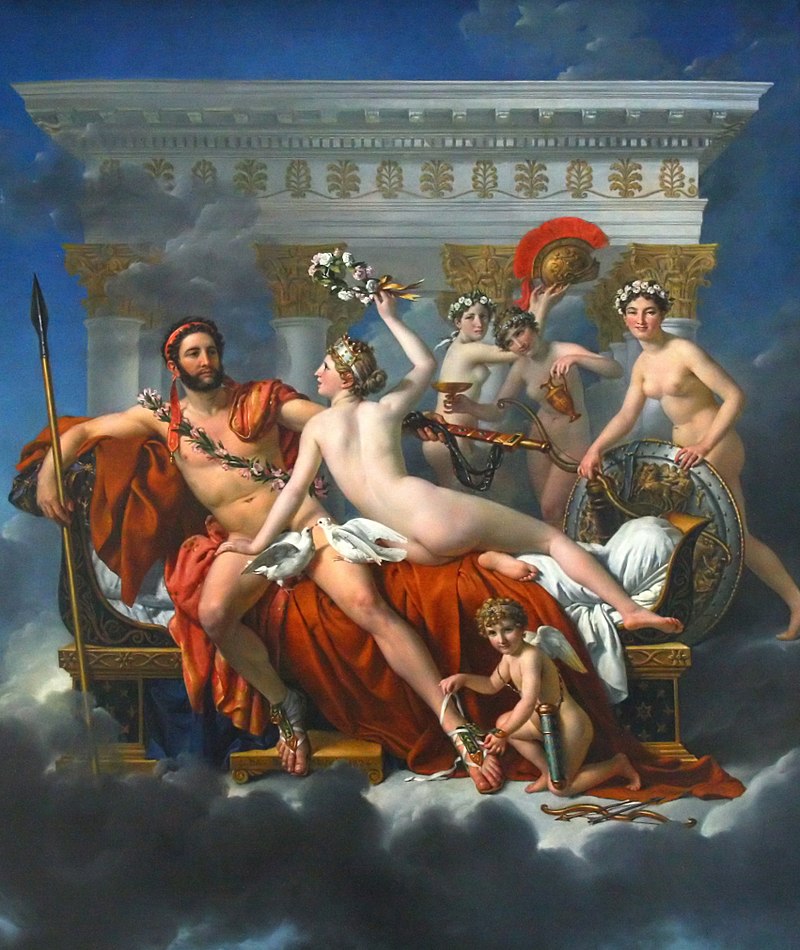
Painting: Mars Disarmed by Venus. Jacques-Louis David

Translation: Copyright © Timothy Adès

More poems by Jean Cassou...

Robert The Devil – I think of you Robert

ROBERT LE DIABLE

Louis Aragon (1897-1982)

ROBERT LE DIABLE
Tu portais dans ta voix comme un chant de Nerval Quand tu parlais du sang jeune homme singulier Scandant la cruauté de tes vers réguliers Le rire des bouchers t'escortait dans les Halles Tu avais en ces jours ces accents de gageure Que j'entends retentir à travers les années Poète de vingt ans d'avance assassiné Et que vengeaient déjà le blasphème et l'injure Je pense à toi Desnos qui partis de Compiègne Comme un soir en dormant tu nous en fis récit Accomplir jusqu'au bout ta propre prophétie Là-bas où le destin de notre siècle saigne Debout sous un porche avec un cornet de frites Te voilà par mauvais temps près de Saint-Merry Dévisageant le monde avec effronterie De ton regard pareil à celui d'Amphitrite Enorme et palpitant d'une pâle buée Et le sol à ton pied comme au sein nu l'écume Se couvre de mégots de crachats de légumes Dans les pas de la pluie et des prostituées Je pense à toi Desnos qui partis de Compiègne Comme un soir en dormant tu nous en fis récit Accomplir jusqu'au bout ta propre prophétie Là-bas où le destin de notre siècle saigne Et c'est encore toi sans fin qui te promènes Berger des longs désirs et des songes brisés Sous les arbres obscurs dans les Champs-Elysées Jusqu'à l'épuisement de la nuit ton domaine O la Gare de l'Est et le premier croissant Le café noir qu'on prend près du percolateur Les journaux frais les boulevards pleins de senteur Les bouches du métro qui captent les passants Je pense à toi Desnos qui partis de Compiègne Comme un soir en dormant tu nous en fis récit Accomplir jusqu'au bout ta propre prophétie Là-bas où le destin de notre siècle saigne La ville un peu partout garde de ton passage Une ombre de couleur à ses frontons salis Et quand le jour se lève au Sacré-Cœur pâli Quand sur le Panthéon comme un équarissage Le crépuscule met ses lambeaux écorchés Quand le vent hurle aux loups dessous le Pont-au-Change Quand le soleil au Bois roule avec les oranges Quand la lune s'assied de clocher en clocher Je pense à toi Desnos qui partis de Compiègne Comme un soir en dormant tu nous en fis récit Accomplir jusqu'au bout ta propre prophétie Là-bas où le destin de notre siècle saigne
Robert The Devil – I think of you Robert
Your voice was charged with something of Nerval You spoke of blood most singular young man Your cruel formal verse you made it scan Laughter of butchers flanked you in Les Halles You seemed already to be laying odds Across the years I hear the resonance Poetic tyro slaughtered in advance Avenged back then by sneers at men and gods You left Compiègne I think of you Robert Just as asleep one evening you had said So you fulfilled that prophecy you made Fate of our century lies bleeding there Stood in a doorway with a twist of fries St Merry overhung by thunderclouds Impertinently staring down the crowds You gazed like royal-blood Nereides Enormous throbbing with a pallid haze Ground at your foot like foam at breast of nude Thick with fag-ends and cabbage chewed and spewed Footfall of rain and all-too-ready lays You left Compiègne I think of you Robert Just as asleep one evening you had said So you fulfilled that prophecy you made Fate of our century lies bleeding there It’s you it still is you still strolling on Shepherd of long desires dead reveries The Champs-Elysées dim below the trees Until your own domain the night is gone O Gare de l’Est first croissant of the day Black coffee percolated freshly poured Crisp morning papers pungent boulevard The metro-mouths where figures drained away You left Compiègne I think of you Robert Just as asleep one evening you had said So you fulfilled that prophecy you made Fate of our century lies bleeding there Your passing haunts the city’s grimy brows With coloured shade The Sacré-Cœur is wan As knacker daybreak flays the Pantheon With shreds and tatters Later in the Bois The sun rolls oranges itself an orange The moon transfers her seat from tower to tower Striking the belfries as they strike the hour And the wind howls beneath the Pont-au -Change You left Compiègne I think of you Robert Just as asleep one evening you had said So you fulfilled that prophecy you made Fate of our century lies bleeding there

Translation: Copyright © Timothy Adès

More poems by Louis Aragon...