Early Spring

Vorfrühling

Rainer Maria Rilke (1875-1926)

Vorfrühling
Härte schwand. Auf einmal legt sich Schonung an der Wiesen aufgedecktes Grau. Kleine Wasser ändern die Betonung. Zärtlichkeiten, ungenau, greifen nach der Erde aus dem Raum. Wege gehen weit ins Land und zeigens. Unvermutet siehst du seines Steigens Ausdruck in dem leeren Baum.
Early Spring
Stiffness, gone. And now a softness settles on the fields’ grey cover. Little streams try out new noises. Indeterminate caresses reach for Earth from somewhere over. Lanes run clear across the land. Spring is suddenly at hand: on the bare tree, see its traces.

Translation: Copyright © Timothy Adès

More poems by Rainer Maria Rilke...

The Wind’s a Whistler

Es pfeift der Wind . . .

Christian Morgenstern (1871-1914)

Es pfeift der Wind . . .
Es pfeift der Wind. Was pfeift er wohl? Eine tolle, närrische Weise. Er pfeift auf einem Schlüssel hohl, bald gellend und bald leise. Die Nacht weint ihm den Takt dazu mit schweren Regentropfen, die an der Fenster schwarze Ruh ohn End eintönig klopfen. Es pfeift der Wind. Es stöhnt und gellt. Die Hunde heulen im Hofe. Er pfeift auf diese ganze Welt, der große Philosophe.
The Wind’s a Whistler
The wind’s a whistler. His will be a melody mad and mental, all in a single dismal key, now bellowing, now gentle. Night weeps the pulse that he maintains, sends heavy raindrops pounding on the black peaceful window-panes, relentlessly resounding. A roaring, groaning sibilant, In all the world he’ll whistle. Let yard-dogs rant: he’s Newton, Kant, Socrates, Bertrand Russell.

Translation: Copyright © Timothy Adès

More poems by Christian Morgenstern...

The Willow Catkin

Das Weidenkätzchen

Christian Morgenstern (1871-1914)

Das Weidenkätzchen
Kätzchen ihr der Weide, wie aus grauer Seide, wie aus grauem Samt! O ihr Silberkätzchen, sagt mir doch, ihr Schätzchen, sagt, woher ihr stammt. Wollen's gern dir sagen: Wir sind ausgeschlagen aus dem Weidenbaum, haben winterüber drin geschlafen, Lieber, in tieftiefem Traum. In dem dürren Baume in tieftiefem Traume habt geschlafen ihr? In dem Holz, dem harten war, ihr weichen, zarten, euer Nachtquartier? Mußt dich recht besinnen: Was da träumte drinnen, waren wir noch nicht, wie wir jetzt im Kleide blühn von Samt und Seide hell im Sonnenlicht. Nur als wie Gedanken lagen wir im schlanken grauen Baumgeäst; unsichtbare Geister, die der Weltbaumeister dort verweilen lässt. Kätzchen ihr der Weide, wie aus grauer Seide, wie aus grauem Samt! O ihr Silberkätzchen, ja, nun weiß, ihr Schätzchen, ich, woher ihr stammt.  
The Willow Catkin
You catkins of willow, silk-grey, velvet-grey, silver catkins, o say: my sweetings, o tell me, how came you this way? We’ll happily say: the willow’s our home, and from it we come; we slept winter away, deep, deep was our dream. In bare trees to sleep, and dreaming so deep? You are tender! How could that be? Was it good, hard night in the wood? Consider aright: we dreamed in the glade, not yet so arrayed as now we’re displayed, silk, velvet, grey shade, by sun shining bright. Like pure meditation in bare boughs we lay, boughs narrow and grey, unseen inspiration: the Lord of creation allowed us to stay. You catkins of willow, silk-grey, velvet-grey, silver catkins, I pay respects to you, sweetings: you’ve told me the way you came here, today.

Translation: Copyright © Timothy Adès

More poems by Christian Morgenstern...

I just saw the wind

Jüngst sah ich den Wind

Arno Holz (1863-1929)

Jüngst sah ich den Wind
Jüngst sah ich den Wind, das himmlische Kind, als ich träumend im Walde gelegen, und hinter ihm schritt mit trippelndem Tritt sein Bruder, der Sommerregen. In den Wipfeln da ging′ s nach rechts und nach links, als wiegte der Wind sich im Bettchen; und sein Brüderchen sang: »Die Binke, die Bank,« und schlüpfte von Blättchen zu Blättchen. Weiß selbst nicht, wie′ s kam, gar zu wundersam es regnete, tropfte und rauschte, daß ich selber ein Kind, wie Regen und Wind, das Spielen der beiden belauschte. Dann wurde es Nacht, und eh ich′ s gedacht, waren fort, die das Märchen mir schufen. Ihr Mütterlein hatte sie fein hinauf in den Himmel gerufen.
I just saw the wind
I just saw the wind, That heavenly lad, As deep in the wood I lay dreaming: And who came behind With light-footed tread But his brother, the summer rain, streaming. The treetops were swayed To one side and t’other As if the wind played At rocking his bed To the song of his brother Who crooned as he slid From one leaf to another. How it was, there’s no knowing, Too wondrous to say, The raining and dripping and blowing: A child, there I lay, And children were they, Rain and wind, and I harked to their playing. And then the night fell And before I could tell, They were gone, who the magic had woven. The mother so kind Of rain and of wind Had called them back up into heaven.

Translation: Copyright © Timothy Adès

More poems by Arno Holz...

Uricon

On Wenlock Edge

A E Housman (1859-1936)

Not avoiding A, I, O, or U
On Wenlock Edge
On Wenlock Edge the wood's in trouble; His forest fleece the Wrekin heaves; The gale, it plies the saplings double, And thick on Severn snow the leaves. 'Twould blow like this through holt and hanger When Uricon the city stood: 'Tis the old wind in the old anger, But then it threshed another wood. Then, 'twas before my time, the Roman At yonder heaving hill would stare: The blood that warms an English yeoman, The thoughts that hurt him, they were there. There, like the wind through woods in riot, Through him the gale of life blew high; The tree of man was never quiet: Then 'twas the Roman, now 'tis I. The gale, it plies the saplings double, It blows so hard, 'twill soon be gone: To-day the Roman and his trouble Are ashes under Uricon.
Uricon
Wind on Long Mynd puts woods in anguish; On Clun, a sylvan shag rains down. Caught in that blast, frail saplings languish; Sabrina dons a milfoil gown. Thus did it blow through holt and gully Whilst Roman Viroconium stood. It blows today; its tantrums bully A Saxon, not a Roman, wood. I wasn’t born, as far-flung Roman Saw, long ago, that windblown hill. Such blood still warms a Saxon ploughman, As his; such hurtful thoughts, hurt still. That wind has wildwoods now in labour, And through yon Roman it ran high. Not tranquil is our human arbour! It was a Roman; now, ’tis I. Caught in that blast, frail saplings languish; It blows so hard, ’twill pass anon: What hid that Roman and his anguish? Ruin and dust of Uricon.
Published online by the Poetry Society: https://www.placesofpoetry.org.uk/

Translation: Copyright © Timothy Adès

More poems by A E Housman...

Ver hiemem indagat...

When the Hounds of Spring Are on Winter's Traces

Algernon Swinburne (1837-1909)

Latin by Timothy Adès
When the Hounds of Spring Are on Winter's Traces
💜When the hounds of spring are on winter's traces,       The mother of months in meadow or plain Fills the shadows and windy places       With lisp of leaves and ripple of rain; And the brown bright nightingale amorous Is half assuaged for Itylus, For the Thracian ships and the foreign faces,       The tongueless vigil, and all the pain. 💜Come with bows bent and with emptying of quivers,       Maiden most perfect, lady of light, With a noise of winds and many rivers,       With a clamor of waters, and with might; Bind on thy sandals, O thou most fleet, Over the splendor and speed of thy feet; For the faint east quickens, the wan west shivers,       Round the feet of the day and the feet of the night. 💜Where shall we find her, how shall we sing to her,       Fold our hands round her knees, and cling? O that man's heart were as fire and could spring to her,       Fire, or the strength of the streams that spring! For the stars and the winds are unto her As raiment, as songs of the harp-player; For the risen stars and the fallen cling to her,       And the southwest wind and the west wind sing. 💜For winter's rains and ruins are over,       And all the season of snows and sins; The days dividing lover and lover,       The light that loses, the night that wins; And time remembered is grief forgotten, And frosts are slain and flowers begotten, And in green underwood and cover       Blossom by blossom the spring begins. 💜The full streams feed on flower of rushes,       Ripe grasses trammel a traveling foot, The faint fresh flame of the young year flushes       From leaf to flower and flower to fruit; And fruit and leaf are as gold and fire, And the oat is heard above the lyre, And the hoofed heel of a satyr crushes       The chestnut-husk at the chestnut-root. 💜And Pan by noon and Bacchus by night,       Fleeter of foot than the fleet-foot kid, Follows with dancing and fills with delight       The Maenad and the Bassarid; And soft as lips that laugh and hide The laughing leaves of the trees divide, And screen from seeing and leave in sight       The god pursuing, the maiden hid. 💜The ivy falls with the Bacchanal's hair       Over her eyebrows hiding her eyes; The wild vine slipping down leaves bare       Her bright breast shortening into sighs; The wild vine slips with the weight of its leaves, But the berried ivy catches and cleaves To the limbs that glitter, the feet that scare       The wolf that follows, the fawn that flies.
Ver hiemem indagat...
ver hiemem indagat: latrans vestigia pellit: ~~ nutrit prata Ceres et novus annus agros: murmura crebrescunt pluviae frondisque susurri, ~~ dum repleant tenebras aeriosque locos: fuscaque rursus amans minuit Philomela dolorem, ~~ clara nitens, neque Ityn iam velut ante gemit: mente cadunt Thressae naves et barbara turba ~~ et quantus vigili lingua resecta dolor. at venias, virgo sanctissima, lucis origo: ~~ tende ferox arcum: prompta sagitta micet! detque sonum surgens multo cum flumine ventus: ~~ detque sonum raucae vis resonantis aquae. indue tu soleas, o velocissima cursu: ~~ ornetur rapidi splendida forma pedis: nam veniente die veniente et nocte tremescit ~~ pallidus, en! Zephyrus, regna et Eoa nitent. queis quaerenda locis numerisve adfanda puella est? ~~ haereat apprendens qua manus arte genu ? o si cor nostrum saliens ceu flamma salutet, ~~ flamma, vel exortae mobile robur aquae ! sidera enim et venti sunt illi talis amictus, ~~ psallentem fertur qui decorasse Linum : illam oriens sidus, delapsum amplectitur illam : ~~ Africus Orpheos dat Zephyrusque sonos. nam sat hiems dederat stragis : iam desiit imber: ~~ diffugere nives: tollitur omne nefas : iam perit et tempus quod amantibus abdit amantes, ~~ quod noctes auget deminuitque dies. iam est memor horarum, maeroris et immemor, idem: ~~ confectum nascens flos fugat acre gelu: iam virgulta virent, frondescunt germina gemmis : ~~ verna sub arbustis incipit ipsa dies. crescit arundinibus pinguis cum floribus amnis: ~~ gramen opimum obstat, quin vetat ire pedem : vix rubet igne novo tener annus, et impiger heres ~~ flos folio, flori denique fructus adest : fructusque et folium splendent velut ignis et aurum, ~~ rustica dum cultam vincit avena lyram, cornipedi et Satyrus contundit calce sub umbra ~~ castaneam siliquam castaneamque nucem. et pede Pan rapido – non acrior haedus eundo! – ~~ tuve movens noctu, Liber, ut ille die, saltibus exagitans mirabilibusque choreis ~~ Maenadas oblectas Bassaridumque comas : et, ceu dissiliunr risu mollita labella, ~~ arboreae molles dissiluere comae : nec latet ille sequens Bacchantem divus amandam, ~~ nec patet adsiduo tecta puella deo. delapsi crines, hedera et delapsa puellae : ~~ cumque superciliis lumina clara latent: labitur et vitis: pectus nudatur anhelum : ~~ occultant nitidum tegmina nulla sinum. sub pede procumbunt oneroso palmite vites: ~~ ipsa hedera haere nti baccare membra capit, membra corusca et turbantes animalia plantas, ~~ seu lupus insequitur, seu cita cerva fugit.
For Swinburne as translator, see Victor Hugo, 'Penniless Children'

Translation: Copyright © Timothy Adès

More poems by Algernon Swinburne...

Moorland Night

Heidenacht

Hermann Allmers (1821-1902)

Heidenacht
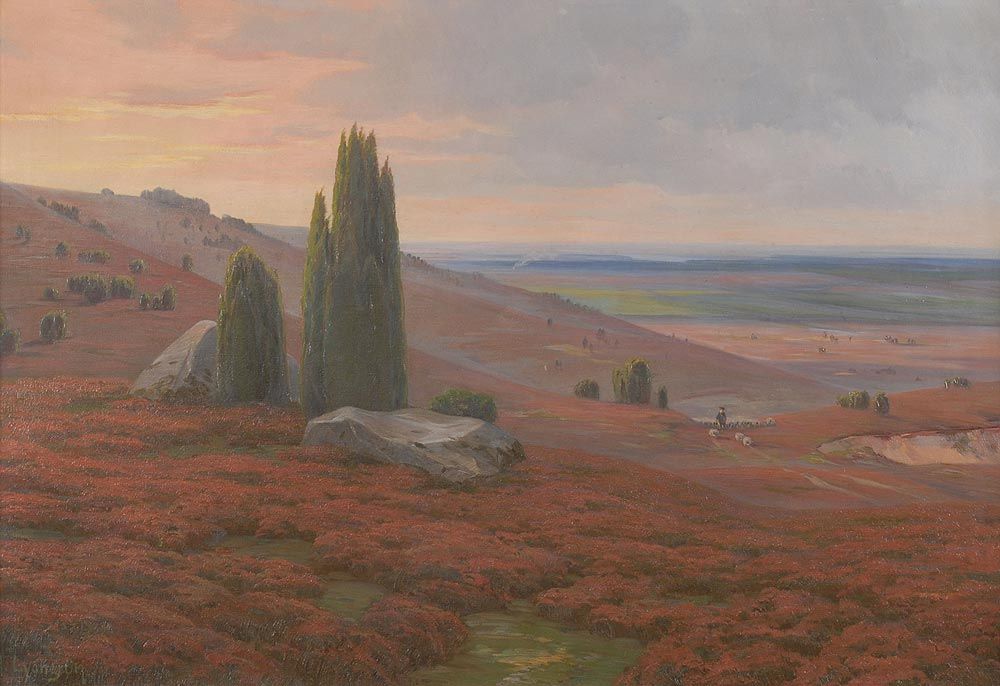
Wenn trüb das verlöschende letzte Rot Herschimmert über die Heide, Wenn sie liegt so still, so schwarz und tot, so weit du nur schauest, die Heide, Wenn der Mond steigt auf und mit bleichem Schein, Erhellt den granitnen Hünenstein, Und der Nachtwind seufzet und flüstert darein Auf der Heide, der stillen Heide. – Das ist die Zeit, dann mußt du gehn Ganz einsam über die Heide, Mußt achten still auf des Nachtwinds Wehn Und des Mondes Licht auf der Heide: Was nie du vernahmst durch Menschenmund, Uraltes Geheimnis, es wird dir kund, Es durchschauert dich tief in der Seele Grund Auf der Heide, der stillen Heide.
Moorland Night
When the sunset’s last sad vanishing red Goes flickering over the moorland, That stretches, black and silent and dead, As you gaze far over the moorland, When the moon climbs high and its pallid glare Is cast on the granite weirdstone there And murmurs and groans fill the restless air Of the moorland, the silent moorland. – That is the time when you must go All alone across the moorland, Must silently heed the winds that blow And the moonlight on the moorland: What you never have learned from the lips of men, The age-old secret, is in your ken, To the depths of your soul you are shaken then, On the moorland, the silent moorland.

Translation: Copyright © Timothy Adès

More poems by Hermann Allmers...

A Green Leaf

Ein grünes Blatt

Theodor Storm (1817 –-88)

Ein grünes Blatt
Ein Blatt aus sommerlichen Tagen, Ich nahm es so im Wandern mit, Auf dass es einst mir möge sagen, Wie laut die Nachtigall geschlagen, Wie grün der Wald, den ich durchschritt.
A Green Leaf
It was a leaf from summer days. I took it on my rambling road That it might sometime serve to tell How loudly sang the nightingale, How green the wood through which I strode.

Translation: Copyright © Timothy Adès

More poems by Theodor Storm...

Butterflies

Les Papillons

Gérard de Nerval (1808-55)

Les Papillons
I De toutes les belles choses Qui nous manquent en hiver, Qu’aimez–vous mieux? — Mois, les roses; — Moi, l’aspect d’un beau pré vert; — Moi, la moisson blondissante; Chevelure des sillons; — Moi, le rossignol qui chante; — Et moi, les beaux papillons! Le papillon, fleur sans tige, Qui voltige, Que l’on cueille en un réseau; Dans la nature infinie, Harmonie, Entre la plante et l’oiseau!… Quand revient l’été superbe, Je m’en vais au bois tout seul: Je m’étends dans la grande herbe, Perdu dans ce vert linceul. Sur ma tête renversée, Là, chacun d’eux à son tour, Passe comme une pensée De poésie ou d’amour! Voici le papillon faune, Noir et jaune; Voici le mars azuré, Agitant des étincelles Sur ses ailes D’un velours riche et moiré. Voici le vulcain rapide, Qui vole comme l’oiseau: Son aile noire et splendide Porte un grand ruban ponceau. Dieux! le soufré, dans l’espace, Comme un éclair a relui… Mais le joyeux nacré passe, Et je ne vois plus que lui! II Comme un éventail de soie, Il déploie Son manteau semé d’argent; Et sa robe bigarrée Est dorée D’un or verdâtre et changeant. Voici le machaon–zèbre, De fauve et de noir rayé; Le deuil, en habit funèbre, Et le miroir bleu strié; Voici l’argus, feuille–morte, Le morio, le grand–bleu, Et la paon–de–jour qui porte Sur chaque aile un œil de feu! * Mais le soir brunit nos plaines; Les phalènes Prennent leur essor bruyant, Et les sphinx aux couleurs sombres, Dans les ombres Voltigent en tournoyant. C’est le grand’paon à l’œil rose Dessiné sur un fond gris, Qui ne vole qu’à nuit close, Comme les chauves–souris; Le bombice du troëne, Rayé de jaune et de vert, Et le papillon du chêne Qui ne meurt pas en hiver! Voici le sphinx à la tête De squelette, Peinte en blanc sur un fond noir, Que le villageois redoute, Sur la route, De voir voltiger le soir. Je hais aussi les phalènes, Sombres, hôtes de la nuit, Qui voltigent dans nos plaines De sept heures à minuit; Mais vous, papillons que j’aime, Légers papillons du jour, Tout en vous est un emblème De poésie et d’amour! III Malheur, papillons que j’aime, Doux emblème, À vous pour votre beauté!… Un doigt, de votre corsage, Au passage, Froisse, hélas! le velouté!… Une toute jeune fille, Au cœur tendre, au doux souris, Perçant vos cœurs d’une aiguille, Vous contemple, l’œil surpris: Et vos pattes sont coupées Par l’ongle blanc qui les mord, Et vos antennes crispées Dans les douleurs de la mort!…
Butterflies
I Of all the fine treasure That winter forecloses, What gives the most pleasure? — For me, I say roses; — For me, fair green meadows; — The ripening harvest, Blonde tress of the furrows; — Nightingale’s melodies; — For me, brilliant butterflies! Butterfly, untethered flower, Leaping and cavorting, yet Captured in a cruel net. Nature’s world, infinity: Bud and bird in harmony! When proud summer comes to pass, I go lonely to the wood. There I lie in tallest grass, Lose myself in the green shroud: Watch above my upturned head Every one of them go by. Thoughts of love, of poetry! See the Monarch butterfly: Black and gold his livery… Purple Emperor in flight, Sparks of light Scurrying On his rich, shot–velvet wing. Red Admiral, he can speed Like a bird: Black and splendid is his wing, Poppy–ribbons blazoning. Brimstone Yellow flashes past, Lightning–fast; Pearl or brown Fritillary, All my field of sight is he: II He spreads like silken fan His mantle silver–sewn: With shifting gold And emerald He gilds his motley gown. Zebra stripe of Swallowtail, Black and tawny–yellow hue; Marbled White, black–draped and pale, Chequered Skipper, streaked with blue; Argus, dead leaf; Camberwell Beauty; Large Blue — rare, so rare; And the Peacock, brandishing, On each wing, Eye of fire! * Brown our fields, at fall of night. See the Moths’ Noisy flight: First a dusky Sphinx, in shade, Twists and turns his escapade. Here comes the Great Peacock Moth, Pink eyes on a grey back–cloth: Like the bats, the flittermice, It’s at nightfall that he flies. Privet Hawk–Moth, funny fellow, Stripes on grub of green and yellow; While the Oak Procession Moth Laughs at winter, cheating death. There’s a Sphinx displays a skull, White on black, piratical: In the byways he appals Villagers, as evening falls. Moths, grim guests of night, I hate: Which in our fields gyrate From seven till too late. But, my precious Butterflies, Fluttering in daylight skies, You are all a symbol of Poetry, a pledge of love. III Woe, my precious butterflies, Who symbolise: Woe betide your loveliness. Passing finger comes to bruise, To abuse Your velvet dress. Some young girl, Tender–hearted, smiling, sweet, Looks in mild surprise on you, Stabs your heart with needle through; And your feet She’ll curtail, Nip with pale Finger–nail, Your antennæ crimp and curl, With a pain that’s terminal!
Translation: Copyright © Timothy Adès

More poems by Gérard de Nerval...

To Aurore [Dawn]

À Aurore

George Sand (1804-76)

To her grand-daughter
À Aurore
La nature est tout ce qu’on voit, Tout ce qu’on veut, tout ce qu’on aime. Tout ce qu’on sait, tout ce qu’on croit, Tout ce que l’on sent en soi-même. Elle est belle pour qui la voit, Elle est bonne à celui qui l’aime, Elle est juste quand on y croit Et qu’on la respecte en soi-même. Regarde le ciel, il te voit, Embrasse la terre, elle t’aime. La vérité c’est ce qu’on croit En la nature c’est toi-même.
To Aurore [Dawn]
Nature’s whatever we see, What we wish for, what we love, What we know and believe to be, What we feel when our heartstrings move. She is beautiful, as we can see, She is kind when we give her our love, She is just when we trust her totally, And respect her, for nature is love. Heaven sees you: look up and see: Earth loves you: give her your love. Truth is what we trust totally, In Nature it’s you, it is love.

Translation: Copyright © Timothy Adès

More poems by George Sand...