Categories
French

Accords

Charles Baudelaire (1821-67)

Correspondances
without using “e”

La Nature est un temple où de vivants piliers
Laissent parfois sortir de confuses paroles;
L’homme y passe à travers des forêts de symboles
Qui l’observent avec des regards familiers.
Comme de longs échos qui de loin se confondent
Dans une ténébreuse et profonde unité,
Vaste comme la nuit et comme la clarté,
Les parfums, les couleurs et les sons se répondent.
Il est des parfums frais comme des chairs d’enfants,
Doux comme les hautbois, verts comme les prairies,
– Et d’autres, corrompus, riches et triomphants,
Ayant l’expansion des choses infinies,
Comme l’ambre, le musc, le benjoin et l’encens,
Qui chantent les transports de l’esprit et des sens.
This world’s a worship-hall: its columnry
Half-murmurs, on and off, a word or two;
Symbols grow thick and tall, as man walks through,
And watch him with familiarity.
A distant, long cacophony confounds
Its clangour in dark gulfs of harmony,
Monstrous as night, and vast as clarity:
A caucus of aromas, colours, sounds!
Fragrant as baby-limbs, mild odours waft
From rolling grasslands, ocarina-soft;
Or arrogant, triumphant, rich and high,
Far out, and growing to infinity,
Musk and patchouli, cinnamon, copal:
Transport and song of spirit, mind and soul.

Translation: Copyright © Timothy Adès
More poems by Charles Baudelaire...

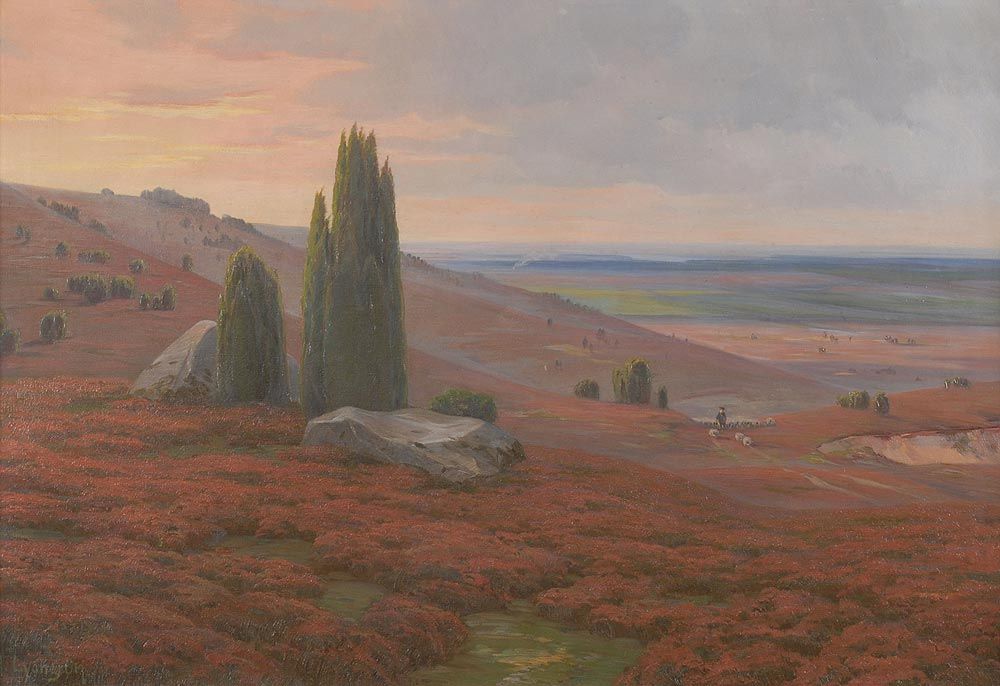
Moorland Night

Heidenacht

Hermann Allmers (1821-1902)

Heidenacht
Wenn trüb das verlöschende letzte Rot Herschimmert über die Heide, Wenn sie liegt so still, so schwarz und tot, so weit du nur schauest, die Heide, Wenn der Mond steigt auf und mit bleichem Schein, Erhellt den granitnen Hünenstein, Und der Nachtwind seufzet und flüstert darein Auf der Heide, der stillen Heide. – Das ist die Zeit, dann mußt du gehn Ganz einsam über die Heide, Mußt achten still auf des Nachtwinds Wehn Und des Mondes Licht auf der Heide: Was nie du vernahmst durch Menschenmund, Uraltes Geheimnis, es wird dir kund, Es durchschauert dich tief in der Seele Grund Auf der Heide, der stillen Heide.
Moorland Night
When the sunset’s last sad vanishing red Goes flickering over the moorland, That stretches, black and silent and dead, As you gaze far over the moorland, When the moon climbs high and its pallid glare Is cast on the granite weirdstone there And murmurs and groans fill the restless air Of the moorland, the silent moorland. – That is the time when you must go All alone across the moorland, Must silently heed the winds that blow And the moonlight on the moorland: What you never have learned from the lips of men, The age-old secret, is in your ken, To the depths of your soul you are shaken then, On the moorland, the silent moorland.

Translation: Copyright © Timothy Adès

More poems by Hermann Allmers...

The hoard of honour in the world

Es kann die Ehre dieser Welt

Theodor Fontane (1819-98)

Es kann die Ehre dieser Welt
Es kann die Ehre dieser Welt Dir keine Ehre geben, Was dich in Wahrheit hebt und hält, Muß in dir selber leben. Wenn's deinem Innersten gebricht An echten Stolzes Stütze, Ob dann die Welt dir Beifall spricht, Ist all dir wenig nütze. Das flücht’ge Lob, des Tages Ruhm Magst du dem Eitlen gönnen; Das aber sei dein Heiligtum: Vor dir bestehen können.
The hoard of honour in the world
The hoard of honour in the world Cannot to thee be giving: The cause, if thou to truth be held, Must in thyself be living. Hast thou in thee no spark of thee Nor proper pride sustaining, Though all may warmly speak of thee, It’s little to thy gaining. The fame of days, the fleeting praise, Are braggart folly’s failing: Be blest in this, to win thy bays By thine own strength prevailing.

Translation: Copyright © Timothy Adès

More poems by Theodor Fontane...

In the garden

Im Garten

Theodor Fontane (1819-98)

Im Garten
Die hohen Himbeerwände Trennten dich und mich, Doch im Laubwerk unsre Hände Fanden von selber sich. Die Hecke konnt es nicht wehren, wie hoch sie immer stund: Ich reichte dir die Beeren Und du reichtest mir deinen Mund. Ach, schrittest du durch den Garten Noch einmal in raschem Gang, Wie gerne wollt ich warten, Warten stundenlang.
In the garden
Tall were the raspberry bushes That parted you from me: But our hands in the foliage Connected easily. The hedge stood high between us, Yet we were not divided. Your mouth reached out, wide open; Who passed the berries? I did. If you should grace the garden Once more with busy stride, How many hours a-waiting I gladly there would bide!
Fontane on the Tay Bridge disaster

Translation: Copyright © Timothy Adès

More poems by Theodor Fontane...

Let Time right it

Überlaß es der Zeit

Theodor Fontane (1819-98)

Überlaß es der Zeit
Erscheint dir etwas unerhört, Bist du tiefsten Herzens empört, Bäume nicht auf, versuch′ s nicht mit Streit, Berühr es nicht, überlaß es der Zeit. Am ersten Tag wirst du feige dich schelten, Am zweiten läßt du dein Schweigen schon gelten, Am dritten hast du′ s überwunden, Alles ist wichtig nur auf Stunden, Ärger ist Zehrer und Lebensvergifter, Zeit ist Balsam und Friedensstifter.
Let Time right it
Unheard-of? Heartfelt rage? Egregious? Affronted? Roused to wrath? Outrageous? Don’t be rampant, don’t try to fight it, Don’t engage with it, let time right it. On day one you’ll be mean, self-scolding, By day two you’ll be mute, withholding, By day three you’ll be fine, all better: A few short hours and nothing can matter. Anger’s a life-destroyer, a poison, Time is a peace-bestower, a balsam.

Translation: Copyright © Timothy Adès

More poems by Theodor Fontane...

Another New Year

Und wieder hier draussen

Theodor Fontane (1819-98)

Und wieder hier draussen
Und wieder hier draußen ein neues Jahr - Was werden die Tage bringen?! Wird's werden, wie es immer war, Halb scheitern, halb gelingen? Wird's fördern das, worauf ich gebaut, Oder vollends es verderben? Gleichviel, was es im Kessel braut, Nur wünsch' ich nicht zu sterben. Ich möchte noch wieder im Vaterland Die Gläser klingen lassen Und wieder noch des Freundes Hand Im Einverständnis fassen. Ich möchte noch wirken und schaffen und tun Und atmen eine Weile, Denn um im Grabe auszuruhn, Hat's nimmer Not noch Eile. Ich möchte leben, bis all dies Glühn Rücklässt einen leuchtenden Funken Und nicht vergeht wie die Flamm' im Kamin, Die eben zu Asche gesunken.
Another New Year
And here outside is another New Year: What will the days be breeding? Will things be just as they always were, Half disaster, half succeeding? Will it foster all upon which I’ve built? Will it destroy, or cherish? Either way, whatever the pot has brewed, I have no desire to perish. I desire again in my own dear land To set the glasses clinking And again to grasp a good friendly hand In mutual concord of thinking. I desire to create and do many a deed And still for a while draw breath, For there is never a pressing need For the graveyard stillness of death. I’d like to live on until all this glow Leaves a shining spark of tinder, Not like the flame in the hearth below That has just collapsed to a cinder.

Translation: Copyright © Timothy Adès

More poems by Theodor Fontane...

The Bridge on the Tay

Die Brück am Tay

Theodor Fontane (1819-98)

Schottland 1879. Shakespeare Macbeth die drei Hexen.
Die Brück am Tay
"Wann treffen wir drei wieder zusamm′?" "Um die siebente Stund′, am Brückendamm." "Am Mittelpfeiler." "Ich lösche die Flamm′." "Ich mit." "Ich komme vom Norden her." "Und ich von Süden." "Und ich vom Meer." "Hei, das gibt ein Ringelreihn, Und die Brücke muss in den Grund hinein." "Und der Zug, der in die Brücke tritt Um die siebente Stund′?" "Ei der muß mit." "Muß mit." "Tand, Tand, Ist das Gebilde von Menschenhand." Auf der Norderseite, das Brückenhaus - Alle Fenster sehen nach Süden aus, Und die Brücknersleut′, ohne Rast und Ruh Und in Bangen sehen nach Süden zu, Sehen und warten, ob nicht ein Licht Übers Wasser hin "ich komme" spricht, "Ich komme, trotz Nacht und Sturmesflug, Ich, der Edinburger Zug." Und der Brückner jetzt: "Ich seh einen Schein Am anderen Ufer. Das muß er sein. Nun Mutter, weg mit dem bangen Traum, Unser Johnie kommt und will seinen Baum, Und was noch am Baume von Lichtern ist, Zünd′ alles an wie zum heiligen Christ, Der will heuer zweimal mit uns sein, - Und in elf Minuten ist er herein." Und es war der Zug. Am Süderturm Keucht er vorbei jetzt gegen den Sturm, Und Johnie spricht: "Die Brücke noch! Aber was tut es, wir zwingen es doch. Ein fester Kessel, ein doppelter Dampf, Die bleiben Sieger in solchem Kampf, Und wie′s auch rast und ringt und rennt, Wir kriegen es unter: das Element." "Und unser Stolz ist unsre Brück′; Ich lache, denk ich an früher zurück, An all den Jammer und all die Not Mit dem elend alten Schifferboot; Wie manche liebe Christfestnacht Hab ich im Fährhaus zugebracht, Und sah unsrer Fenster lichten Schein, Und zählte, und konnte nicht drüben sein." Auf der Norderseite, das Brückenhaus - Alle Fenster sehen nach Süden aus, Und die Brücknersleut′ ohne Rast und Ruh Und in Bangen sehen nach Süden zu; Denn wütender wurde der Winde Spiel, Und jetzt, als ob Feuer vom Himmel fiel′, Erglüht es in niederschießender Pracht Überm Wasser unten … Und wieder ist Nacht. "Wann treffen wir drei wieder zusamm′?" "Um Mitternacht, am Bergeskamm." "Auf dem hohen Moor, am Erlenstamm." "Ich komme." "Ich mit." "Ich nenn euch die Zahl." "Und ich die Namen." "Und ich die Qual." "Hei! Wie Splitter brach das Gebälk entzwei." "Tand, Tand, Ist das Gebilde von Menschenhand."
The Bridge on the Tay
"When shall we three meet again?" "At the seventh hour, at the bridge's dam." "At the middle pier." "I shall quench the flame." "And so shall I." "From the North I’ll come." "From the South I’ll come." “And I from the foam." "Ho, it shall be a ring-around. And the bridge shall sink, shall sink to the ground." "And the train on the bridge, at the seventh hour?" “That too shall be drowned.” “That too shall be drowned.” “Baubles vain, Such is the handiwork of man!” In the bridge house on the northern side The windows look south, and the folk inside anxiously, restlessly, southward gaze, waiting and watching, whether a light over the water speaks amain braving the dark and stormy night: ‘From Edinburgh coming, ’tis I, the train.’ And the bridgeman speaks: “A light I see on the further bank. The train it must be. Now, Mother, an end to your brooding drear, our Jock is coming, he wants his tree, so light every light on the Christmas fir as if for the Christ our Saviour dear. He will come twice for us this year, and in twelve minutes' time he shall be here." And the train was passing the southern tower, straining against the tempest’s power. “Only the bridge,” says Jock. “What then? Tight-wrought boiler, full head of steam, into battle, an unconquered team! For all it may wrestle and rage and rant, we yet shall master the element. “Our bridge is our pride. I recall and laugh, when I think of old times and of all the grief and all the distress with the poor old skiff: how many times past at Christmastide in the ferryman’s house I’ve had to bide and I gazed at our windows’ merry glare and counted the hours and couldn’t be there.” In the bridge house on the northern side the windows look south, and the folk inside anxiously, restlessly, southward gaze, as ever more furious the wild wind plays… And hurtling from heaven a fearsome blaze, a fiery thunderbolt, blinding bright, embroils the water! …Again it is night. “When shall we three meet again?” “At midnight, on the mountain-comb.” “By the alder-stump on the lofty plain.” “I’ll come.” “And I’ll come.” “The number I’ll name.” “I’ll tell every name.” “I’ll tell the pain.” “Ho, how it splintered and split, the span.” “Baubles vain, Such is the handiwork of man!”

Translation: Copyright © Timothy Adès

More poems by Theodor Fontane...

Ending

Ausgang

Theodor Fontane (1819-98)

Ausgang
Immer enger, leise, leise Ziehen sich die Lebenskreise, Schwindet hin, was prahlt und prunkt, Schwindet hoffen, hassen, lieben, Und ist nichts in Sicht geblieben Als der letzte dunkle Punkt.
Ending
Ever tighter draw life’s coils, Gloss decays and glory spoils, Softly, softly, step by step: Hope and hate and love diminish, Nothing left to see: we finish With the final, dark full stop.

Translation: Copyright © Timothy Adès

More poems by Theodor Fontane...

My Life

Mein Leben

Theodor Fontane (1819-98)

Mein Leben
Mein Leben, ein Leben ist es kaum, ich gehe dahin als wie im Traum. Wie Schatten huschen Menschen hin, ein Schatten dazwischen ich selber bin. Und im Herzen tiefe Müdigkeit. Alles sagt mir: Es ist Zeit ...
My Life
My life is hardly a life at all, As if in a dream I go my way. Like shadows, people scurry away, And I’m a shadow among them all. In my heart is a weariness, deepening. It’s time, it’s time, says everything.

Translation: Copyright © Timothy Adès

More poems by Theodor Fontane...

Good King Wenceslas

Categories
Latin

Good King Wenceslas

J M Neale

Translated into Latin by Timothy Adès
Good King Wenceslas looked out On the feast of Stephen When the snow lay round about Deep and crisp and even Brightly shone the moon that night Though the frost was cruel When a poor man came in sight Gath'ring winter fuel "Hither, page, and stand by me If thou know'st it, telling If thou know'st it, telling Yonder peasant, who is he? Where and what his dwelling?" "Sire, he lives a good league hence Underneath the mountain Right against the forest fence By Saint Agnes' fountain." "Bring me flesh and bring me wine Bring me pine logs hither Thou and I will see him dine When we bear him thither." Page and monarch forth they went Forth they went together Through the rude wind's wild lament And the bitter weather "Sire, the night is darker now And the wind blows stronger Fails my heart, I know not how, I can go no longer." "Mark my footsteps, my good page Tread thou in them boldly Thou shalt find the winter's rage Freeze thy blood less coldly." In his master's steps he trod Where the snow lay dinted Heat was in the very sod Which the Saint had printed Therefore, Christian men, be sure Wealth or rank possessing Ye who now will bless the poor Shall yourselves find blessing.
Good King Wenceslas
Wenceslaë, quas nives     prospicis, rex pie, crusta plana stabiles     Stephani in die! lunae lux trans tenebras     monstrat indigentem per pruinas horridas     ligna colligentem.   “Adsta, puer, propius,     narrans forsan testis: unde venit, quae domus,     quis est hic agrestis?” “Tria procul milia     redit hinc sub montem, silvae saepis incola     Agnes iuxta fontem.”   “Fer mi carnem, vinum fer,     pineis cum lignis: hunc visemus, minister,     dapibus benignis.” rex et puer protinus     una properatis, duris in frigoribus     raucae tempestatis.   “Princeps, nox fit caecior,     aquilo bacchatur. nescio quam languet cor:     progredi non datur.” “Vade passibus meis     sanguine tepenti, trucis expers hiemis,     vi non algens venti.”   Calcat passus domini     per nives ingressi: caespites sunt calidi     sancto pede pressi. ergo, potens vel dives,     credas et salveris! benedicens pauperes     tu benediceris.

Translation: Copyright © Timothy Adès

More poems by J M Neale...