Tobacco

Toute l'âme résumée

Stéphane Mallarmé (1842-98)

Also translated by Alfonso Reyes in his Banquet sequence, in my book.
Toute l'âme résumée
Toute l’âme résumée Quand lente nous l’expirons Dans plusieurs ronds de fumée Abolis en autres ronds Atteste quelque cigare Brûlant savamment pour peu Que la cendre se sépare De son clair baiser de feu Ainsi le chœur des romances À la lèvre vole-t-il Exclus-en si tu commences Le réel parce que vil Le sens trop précis rature Ta vague littérature.
Tobacco
The spirit all subsumed by my slow breath consumed between each smoky ring on t’other perishing attests the sage cigar that burns on just the same though ash goes falling far from its bright kiss of flame So the songs and romances flutter up to your lip choose the dearest instances the vile is real let it slip Precision’s the erasure of your vague literature TABACO translation by Alfonso Reyes Toda el alma resumida cuando lenta la consumo entre cada rueda de humo en otra rueda abolida El cigarro dice luego por poco que arda a conciencia La ceniza es decadencia del claro beso de fuego Tal el coro de leyendas hasta tu labio aletea Si has de empezar suelta en prendas Lo vil por real que sea Lo muy preciso tritura tu vaga literatura

Translation: Copyright © Timothy Adès

More poems by Stéphane Mallarmé...

A Toast

Brindis

Stéphane Mallarmé (1842-98)

A quatrain in a letter, 1887, to Méry Laurent, ‘blonde fulgurante’, ‘a summation of France's Third Republic’: enriched by the Emperor’s dentist, painted by Manet, loved by these and by Mallarmé and Reynaldo Hahn and ...
Brindis
Tin tin tin ‘Voici la date, tends un coin De ta fraîche bouche étonnée Où la nature prend le soin De te rajeunir d'une année.’
A Toast
Ding-ding-ding This is your day: your friends are here to strip you of years, like laying bare a fig-tree of figs, a chestnut of spines With smiling lips, approve these lines! ‘Nature,’ said Mallarmé, ‘takes care to make you younger, year by year’. BRINDIS Translation by Alfonso Reyes, in my book of him Tin-tin-tin Llegó la fecha y tus amigos te ven despojarte de años como de erizos los castaños y como la higuera de higos Tiende tu boca a nuestro afán tu boca – dice Mallarmé – “Où la nature prend le soin de te rajeunir d’une année.”
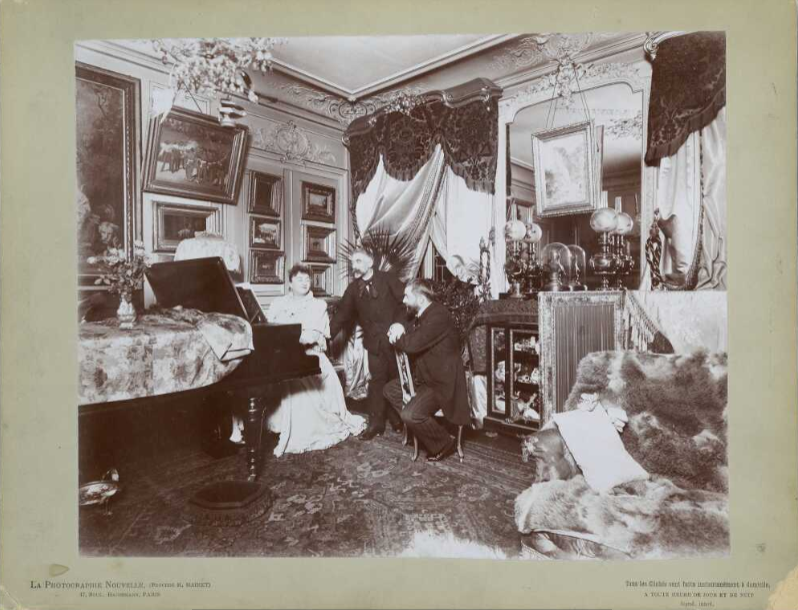
In the Salon: Mallarmé and the painter Henri Gervex. "Le salon que tient Méry Laurent est un lieu d’échanges qui favorise les démarches créatrices de ceux qui le fréquentent : on y rencontre des peintres, tels qu’Édouard Manet ou Henri Gervex, des poètes et des écrivains comme Mallarmé, Coppée, Huysmans, Proust (l’auteur brosse son portrait en la personne d’Odette de Crécy, le plus grand amour de Swann8) ou Zola (qui s’inspire d’elle pour Nana), des sculpteurs, des artistes lyriques et des musiciens, tels qu’Hortense Schneider ou Reynaldo Hahn. Celui-ci sera d’ailleurs son exécuteur testamentaire."

Translation: Copyright © Timothy Adès

More poems by Stéphane Mallarmé...

Goldfinch in Jail

The Caged Goldfinch

Thomas Hardy (1840-1928)

The Caged Goldfinch
Within a churchyard, on a recent grave, I saw a little cage That jailed a goldfinch. All was silence save Its hops from stage to stage. There was inquiry in its wistful eye, And once it tried to sing; Of him or her who placed it there, and why, No one knew anything. True, a woman was found drowned the day ensuing, And some at times averred The grave to be her false one's, who when wooing Gave her the bird.
Goldfinch in Jail
Within a churchyard, on a just-laid plot, I saw a tiny jail: A goldfinch was within. No sound: but, what? Hop, hop, a dismal trail. Inquiry in its wistful look saw I; I saw it fail to sing; Of who had put it in that spot, and why, Folk didn't know a thing. But soon a woman in a brook was found, Spawning this common word: A traitor swain lay in that holy ground; His gift, that bird.

Translation: Copyright © Timothy Adès

More poems by Thomas Hardy...

De virgine perdita

The Ruined Maid

Thomas Hardy (1840-1928)

His English, my Latin
The Ruined Maid
"O 'Melia, my dear, this does everything crown! Who could have supposed I should meet you in Town? And whence such fair garments, such prosperi-ty?" — "O didn't you know I'd been ruined?" said she. — "You left us in tatters, without shoes or socks, Tired of digging potatoes, and spudding up docks; And now you've gay bracelets and bright feathers three!" — "Yes: that's how we dress when we're ruined," said she. — "At home in the barton you said thee' and thou,' And thik oon,' and theäs oon,' and t'other'; but now Your talking quite fits 'ee for high compa-ny!" — "Some polish is gained with one's ruin," said she. — "Your hands were like paws then, your face blue and bleak But now I'm bewitched by your delicate cheek, And your little gloves fit as on any la-dy!" — "We never do work when we're ruined," said she. — "You used to call home-life a hag-ridden dream, And you'd sigh, and you'd sock; but at present you seem To know not of megrims or melancho-ly!" — "True. One's pretty lively when ruined," said she. — "I wish I had feathers, a fine sweeping gown, And a delicate face, and could strut about Town!" — "My dear — a raw country girl, such as you be, Cannot quite expect that. You ain't ruined," said she.
De virgine perdita
‘hoc superat certe, cara o mea Melia, totum: ~~res inopina, ego iens obvia in urbe tibi. unde hae divitiae quot habes et pulcher amictus?’ ~~‘num nescis? quia sum perdita: damnor ego.’ ‘squalebant panni, nudo pede pauper abisti: ~~plus lolia et betas lassa fodire nequis. nunc nitet armillis necnon tribus instita plumis.’ ~~‘tale quidem splendens perdita tegmen habet.’ ‘rure domi tute, en! tibimetque in chorte solebas, ~~hice ollumque et alid, rustica verba loqui. nunc tamen apta bonis tua vox, proceresque iuvabis.’ ~~‘perdita pro damno lautior esse potest.’ ‘dura rudisque manus, pigrum os et pullius: at nunc ~~pellicit et tamquam fascinat ista gena. sunt manicae tenerae, bona quas matrona sitiret!’ ~~‘nulla laborem urget perdita nympha manu.’ ‘ante domi te questa magas vinxisse sopore, ~~ miscebas gemitu murmura. nunc mihi ades expers tristitiae, caput haud cruciata dolore.’ ~~‘vera refers: hilaris perdita nympha viget.’ ‘o si magnificam chlamydem plumasque tenerem, ~~os purum, forti pulchra et in urbe gradu!’ ‘rustica et inconcinna manes. quid? non tibi talis, ~~non tibi, quae non es perdita, vita datur.’

Translation: Copyright © Timothy Adès

More poems by Thomas Hardy...

The Stranger

L’Étranger

René François Armand Sully-Prudhomme (1839-1907)

L’Étranger
Je me dis bien souvent : de quelle race es-tu ? Ton coeur ne trouve rien qui l'enchaîne ou ravisse, Ta pensée et tes sens, rien qui les assouvisse : Il semble qu'un bonheur infini te soit dû. Pourtant, quel paradis as-tu jamais perdu ? A quelle auguste cause as-tu rendu service ? Pour ne voir ici-bas que laideur et que vice, Quelle est ta beauté propre et ta propre vertu ? A mes vagues regrets d'un ciel que j'imagine, A mes dégoûts divins, il faut une origine : Vainement je la cherche en mon coeur de limon ; Et, moi-même étonné des douleurs que j'exprime, J'écoute en moi pleurer un étranger sublime Qui m'a toujours caché sa patrie et son nom.
The Stranger
I often ask myself: What breed are you? Your heart remains unravished, unenslaved; There’s nothing that your thoughts and senses craved; Eternal happiness must be your due. And yet, what paradise did you forego? What worthy cause have you done service to? Confined to vice and squalor here below, What’s your own beauty and your own virtue? My longing for some heaven, my divine Uneasiness, must have some origin; I seek it vainly in my turbid heart. Amazed at my pathetic litany, I hear a noble stranger weep in me, Who won’t his country, or his name, impart.

Translation: Copyright © Timothy Adès

More poems by René François Armand Sully-Prudhomme...

At the old Jewish Cemetery

Prag: Auf dem alten jüdischen Friedhofe

Ada Christen (1839-1901)

Prag: Auf dem alten jüdischen Friedhofe
Sinnend stand ich bei dem Grabe Rabby Löv's, des jüd'schen Weisen, Hörte wie im Traum den Führer Seine todten Ahnherrn preisen. Und warum, so frug ich staunend, All' die Juden, groß und kleine, Auf das Grab mit leisem Murmeln Werfen bunte Kieselsteine? Und es wurde mir die Antwort: "Um zu ehren, ist geboten, Daß wir Blumen streu'n Lebend'gen, Steine auf das Grab der Todten." Von solch' heidnischem Gebrauche Sind wir Christen längst gereinigt: Wir bekränzen stets die Gräber Jener, welche wir gesteinigt.
At the old Jewish Cemetery
I stood thoughtful at his graveside, Rabbi Loew’s, the Jewish sage, And the guide, perhaps I dreamed it, Praised his long-dead parentage. Why are Jews, I asked in wonder, Children and the fully grown, One and all, with quiet murmurs Throwing pretty pebbles on? ‘It’s to honour him,’ they answered: ‘Flowers are prohibited. They are strewn upon the living; Stones are proper for the dead.’ Long ago, such heathen customs By us Christians were disowned: No, instead we heap up flowers On the graves of those we stoned.

Translation: Copyright © Timothy Adès

More poems by Ada Christen...

The Laurel

H δάφνη

Achilleas Paraschos (1838-95)

H δάφνη
Μή με ζηλεύετε· κανείς τή δάφνη μή ζηλεύει· μ’ αίμα καί δάκρυ πύρινο τή ρίζα μου ποτίζουν. Καλότυχος όποιος ποτέ τή δάφνη δέν γυρεύει, καί μόνον τά τριαντάφυλλα τό στήθος του στολίζουν. Κοινό στεφάνο μ’έχουνε η δόξα καί ο πόνος, καί τά θλιμμέν’απόπαιδα τής μοίρας μ’ έχουν μόνο. Κάθε μου φύλλο άδοξος τό φαρμακεύει φθόνος· γιά τούτο μόνο ποιητάς τού κόσμου στεφανώνω.
The Laurel
‘Envy me not. Let not one soul envy the laurel-tree. My roots quaff blood and burning tears, for thus they water me. Happy the man who never made the laurel-wreath his quest, And has no more than roses to decorate his breast. I am a crown that’s common to glory and to pain; My every leaf is poisoned, base jealousy’s my bane. Only those wretches wear me whom fortune forth has hurled, And that alone is why I crown the poets of the world.’

Translation: Copyright © Timothy Adès

More poems by Achilleas Paraschos...

The Secret

Le Secret

Armand Silvestre (1837-1901)

An ‘X’ (a graduate of the École Polytechnique), he was an Inspector of Finances, one of the highest officials in France. His drama Henry VIII was set to music by Saint–Saens, and a sacred stage work was set by Gounod. He wrote five illustrated volumes on the nude in art. Set to music by Fauré.
Le Secret
Je veux que le matin l'ignore Le nom que j'ai dit à la nuit, Et qu'au vent de l'aube, sans bruit, Comme une larme il s'évapore. Je veux que le jour le proclame L'amour qu'au matin j'ai caché, Et, sur mon coeur ouvert penché, Comme un grain d'encens il l'enflamme. Je veux que le couchant l'oublie Le secret que j'ai dit au jour, Et l'emporte, avec mon amour, Aux plis de sa robe pâlie!
The Secret
O may the morn never know it, the name that I spoke to the night: may it vanish mute as a tear-drop on the breeze of the early light. O may the noonday proclaim it, the love that I hid from the morn: may it light on my heart, laid open; may my heart like an incense burn. O may dusk forget my secret, forget what I told to the day: in its robe’s pale folds may it carry my love and my secret away.
Published in AGENDA Poetry & Opera 2014

Translation: Copyright © Timothy Adès

More poems by Armand Silvestre...

Testament

Set to music by Duparc.

Armand Silvestre (1837-1901)

Set to music by Duparc.
Pour que le vent te les apporte Sur l’aile noire d’un remord, J’écrirai sur la feuille morte Les tortures de mon coeur mort! Toute ma sève s’est tarie Aux clairs midis de ta beauté, Et, comme à la feuille flétrie, Rien de vivant ne m’est resté Tes yeux m’ont brulé jusqu’à l’âme, Comme des soleils sans merci! Feuille que le gouffre réclame, L’autan va m’emporter aussi ... Mais avant, pour qu’il te les porte Sur l’aile noire d’un remord, J’écrirai sur la feuille morte Les tortures de mon coeur mort!
Testament
For the wind to bring you On remorse’s black wing, On the dead leaf I’ll write My dead heart’s suffering. My sap is all withered In your beauty’s bright noon: Like the leaf that is faded My life is all gone. Cruel suns are your eyes, To my soul I am burned: A leaf to the chasm, Borne off by south wind. This, first, it shall bring you On remorse’s black wing: On the dead leaf I’ll write My dead heart’s suffering.
Published in AGENDA Poetry & Opera 2014

Translation: Copyright © Timothy Adès

More poems by Armand Silvestre...

Poème d’amour

Love Poem

Armand Silvestre (1837-1901)

Love Poem
Je veux que mon sang goutte à goutte Monte à ta lèvre lentement.1 Comme un flot limpide et calmant, De ton cœur il prendra la route. Bois-le : mon âme y sera toute Dans un suprême enivrement : Car le seul mal que je redoute, C’est de survivre à mon tourment.2 Bois-le sans honte et sans peurs vaines : Ce trésor sacré de mes veines, Toi seule pourras le tarir.3 Avec mon souffle, avec mon âme,4 Ce sang que ta bouche réclame, Bois-le ! – Car j’ai soif de mourir !
Poème d’amour
Drop by drop my blood must drip, Climbing slowly to your lip, Like a calm and limpid wave, To your heart: no less, I crave. Drink it: all my soul shall be In the height of ecstasy. My one dread, one injury: To survive my agony. Feel no shame: all fears are vain: These my vessels you shall drain: Yours, my sacred treasury. Drink my soul and drink my breath, Drink my blood, assuage your mouth. Drink it! For I thirst to die!
1. N. Boulanger écrit à tes lèvres 2. Vers répété par N. Boulanger 3. N. Boulanger répète d’abord deux fois Toi seule puis, en reprenant le vers, 3 fois. 4. N. Boulanger écrit Avec mon cœur, avec mon âme

Translation: Copyright © Timothy Adès

More poems by Armand Silvestre...