In the pink dawn, it snowed
Il a neigé dans l’aube rose
Maurice Carême (1899-1978)
Il a neigé dans l’aube rose
Il a neigé dans l’aube rose,
Si doucement neigé
Que le chaton noir croit rêver.
C’est à peine s’il ose
Marcher.
Il a neigé dans l’aube rose,
Si doucement neigé
Que les choses
Semblent avoir changé.
Et le chaton noir n’ose
S’aventurer dans le verger,
Se sentant soudain étranger
À cette blancheur où se posent
Comme pour le narguer,
Des moineaux effrontés.
In the pink dawn, it snowed
In the pink dawn, it snowed,
so gently, it snowed.
Black cat thinks he’s dreaming,
to walk would be danger.
In the pink dawn, it snowed,
so gently, it snowed.
Looks like a game-changer!
Black cat will not enter
the orchard, won’t venture,
feels, hey! I’m a stranger
in this white winter.
The pert sparrows cheek him.
Translation: Copyright © Timothy Adès
More poems by Maurice Carême...
You are lovely, dear mother
Tu es belle, ma mère
Maurice Carême (1899-1978)
Tu es belle, ma mère
Tu es belle, ma mère,
Comme un pain de froment.
Et, dans tes yeux d'enfant,
Le monde tient à l'aise.
Ta chanson est pareille
Au bouleau argenté
Que le matin couronne
D'un murmure d'abeilles.
Tu sens bon la lavande,
La cannelle et le lait ;
Ton cœur candide et frais
Parfume la maison.
Et l'automne est si doux
Autour de tes cheveux
Que les derniers coucous
Viennent te dire adieu.
You are lovely, dear mother
You are lovely, dear mother,
As good wheaten bread;
In your two childish eyes
The world’s comforted.
Your melody breathes
Like silver birch trees
That morning-time wreathes
With murmur of bees.
Your scent is blue lavender,
Milk, cinnamomum,
Your heart pure and tender
Suffuses our home, Mum.
So sweet round your head
The autumn loves you:
The last of the cuckoos
Tells you fondly ‘Adieu.’
Translation: Copyright © Timothy Adès
More poems by Maurice Carême...
The Ladybird
La Coccinelle
Maurice Carême (1899-1978)
La Coccinelle
Je ris dans les bluets,
Je mange dans les lis,
Je lis dans les oeillets,
Je bois dans les narcisses.
Et, couchée dans les citronnelles,
Je rêve si longtemps de bleu,
Moi, la petite coccinelle,
Que je deviens bête à bon Dieu.
The Ladybird
I laugh among the cornflowers,
I dine among the lilies,
I read among the gillyflowers,
Drink in the daffodillies.
I slumber in verbena,
In the blue my dreams have soared:
That’s why in French they call me
The beetle of the Lord.
Translation: Copyright © Timothy Adès
More poems by Maurice Carême...
Up from the Country
Besuch vom Lande
Erich Kästner (1899-1974)
Besuch vom Lande
Sie stehen verstört am Potsdamer Platz
Und finden Berlin zu laut.
Die Nacht glüht auf in Kilowatts.
Ein Fräulein sagt heiser: "Komm mit, mein Schatz!"
Und zeigt entsetzlich viel Haut.
Sie wissen vor Staunen nicht aus und nicht ein.
Sie stehen und wundern sich bloß.
Die Bahnen rasseln. Die Autos schreien.
Sie möchten am liebsten zu Hause sein
Und finden Berlin zu groß.
Es klingt, als ob die Großstadt stöhnt,
weil irgendwer sie schilt.
Die Häuser funkeln. Die U-Bahn dröhnt.
Sie sind alles so gar nicht gewöhnt
Und finden Berlin zu wild.
Sie machen vor Angst die Beine krumm.
Sie machen alles verkehrt.
Sie lächeln bestürzt. Und sie warten dumm
Und stehn auf dem Potsdamer Platz herum,
bis man sie überfährt.
Up from the Country
They stand in confusion on Potsdamer Platz,
Berlin, they find, is a din.
The night is glowing in kilowatts.
‘Come along, my sweet’ purrs a Fräulein that’s
Showing indecent skin.
They stand not sure what their feet are for,
Stock still in utter surprise.
The railroads rattle, the motors roar,
They long for home where they were before,
They find Berlin is outsize.
It sounds as if the big city groans
Because it is being told off.
The houses glitter. The U-Bahn drones,
They are out, far out of their comfort-zones,
They find Berlin too rough.
Their knees are knocking, they’re scared, they’re hexed,
It’s a mess, they’re not in clover.
They smile, struck dumb. And they wait, perplexed.
They linger on Potsdamer Platz. What next?
Somebody runs them over.
Translation: Copyright © Timothy Adès
More poems by Erich Kästner...
Three Snails
Trois escargots
Maurice Carême (1899-1978)
Trois escargots
J’ai rencontré trois escargots
Qui s’en allaient cartable au dos
Et, dans le pré, trois limaçons
Qui disaient par cœur leur leçon.
Puis, dans un champ, quatre lézards
Qui écrivaient un long devoir.
Où peut se trouver leur école ?
Au milieu des avoines folles ?
Peut-être est-ce une aristoloche
Qui leur sert de petite cloche
Et leur maître est-il ce corbeau
Que je vois dessiner là-haut
De belles lettres au tableau ?
Three Snails
Three snails with satchels came in view,
I saw their laden backs depart;
and in the meadow, three slugs who
spouted their lesson, learnt by heart;
and then, four lizards in a field:
long was the exercise they wrote.
Where can their schoolhouse be concealed?
Amid the scrub of the wild oat?
Perhaps they have a calico
flower to be their little bell,
and could their master be the crow
that I can see from far below,
who at his blackboard writes so well?
Translation: Copyright © Timothy Adès
More poems by Maurice Carême...
Like a Railway
Das Eisenbahngleichnis
Erich Kästner (1899-1974)
Das Eisenbahngleichnis
Wir sitzen alle im gleichen Zug
und reisen quer durch die Zeit.
Wir sehen hinaus. Wir sahen genug.
Wir fahren alle im gleichen Zug
und keiner weiß, wie weit.
Ein Nachbar schläft; ein andrer klagt;
ein dritter redet viel.
Stationen werden angesagt.
Der Zug, der durch die Jahre jagt,
kommt niemals an sein Ziel.
Wir packen aus, wir packen ein.
Wir finden keinen Sinn.
Wo werden wir wohl morgen sein?
Der Schaffner schaut zur Tür herein
und lächelt vor sich hin.
Auch er weiß nicht, wohin er will.
Er schweigt und geht hinaus.
Da heult die Zugsirene schrill!
Der Zug fährt langsam und hält still.
Die Toten steigen aus.
Ein Kind steigt aus, die Mutter schreit
Die Toten stehen stumm
am Bahnsteig der Vergangenheit.
Der Zug fährt weiter, er jagt durch die Zeit,
und keiner weiß, warum.
Die erste Klasse ist fast leer.
Ein feister Herr sitzt stolz
im roten Plüsch und atmet schwer.
Er ist allein und spürt das sehr
Die Mehrheit sitzt auf Holz.
Wir reisen alle im gleichen Zug
zur Gegenwart in spe.
Wir sehen hinaus. Wir sahen genug.
Wir sitzen alle im gleichen Zug
und viele im falschen Coupé.
Like a Railway
We’re all aboard the same chuff-chuff,
We travel through existence.
We’re peering out, we’ve seen enough,
We’re all of us on the same chuff-chuff,
None of us knows the distance.
One neighbour sleeps, another sneers,
A third has thoughts to share.
The list of halts assaults our ears,
The train goes chasing through the years,
Never quite getting there.
We spread our gear, we stow our gear,
We find it so confusing.
Tomorrow we’ll be – where? – not here.
Ticket-collector looming near
Smiles at us. How amusing!
And where’s he bound? Blowed if he knows.
He’s gone, he’s told us nowt.
The powerful shrill whistle blows,
The train puts on the brakes and slows
And stops. The dead get out.
A child gets out, the mother screams.
On platforms of the past
The horde of Death, unspeaking, teems.
The train, time-traveller, onward steams.
Everyone is nonplussed.
First class, there’s hardly anyone.
Plump gentleman sits proud,
Breathes heavily on red plush throne.
He’s well aware he is alone.
Wood benches for the crowd.
We’re all aboard the same chuff-chuff,
Quite hopeful, just at present.
We’re peering out, we’ve seen enough,
We’re sitting in the same chuff-chuff,
Some in the wrong compartment.
Translation: Copyright © Timothy Adès
More poems by Erich Kästner...
Springtime will return
Le printemps reviendra
Maurice Carême (1899-1978)
Le printemps reviendra
Hé oui, je sais bien qu'il fait froid,
Que le ciel est tout de travers ;
Je sais que ni la primevère
Ni l'agneau ne sont encore là.
La terre tourne ; il reviendra,
Le printemps, sur son cheval vert.
Que ferait le bois sans pivert,
Le petit jardin sans lilas ?
Oui, tout passe, même l'hiver,
Je le sais par mon petit doigt
Que je garde toujours en l'air …
Springtime will return
Yes, I know we have cold weather,
And the sky is not playing fair;
And I know that at present, neither
The lamb nor the primrose is there.
The world will turn, and the springtime
Will return, astride its green mare.
No woodpecker, what’ll the wood do?
The garden, with no syringa?
All things must pass, even winter:
I know, by my little pink finger
That’s always up in the air…
Translation: Copyright © Timothy Adès
More poems by Maurice Carême...
May
Der Mai
Erich Kästner (1899-1974)
Der Mai
Im Galarock des heiteren Verschwenders,
ein Blumenzepter in der schmalen Hand,
fährt nun der Mai, der Mozart des Kalenders,
aus seiner Kutsche grüßend, über Land.
Es überblüht sich, er braucht nur zu winken.
Er winkt! Und rollt durch einen Farbenhain.
Blaumeisen flattern ihm voraus und Finken.
Und Pfauenaugen flügeln hinterdrein.
Die Apfelbäume hinterm Zaun erröten.
Die Birken machen einen grünen Knicks.
Die Drosseln spielen, auf ganz kleinen Flöten,
das Scherzo aus der Symphonie des Glücks.
Die Kutsche rollt durch atmende Pastelle.
Wir ziehn den Hut. Die Kutsche rollt vorbei.
Die Zeit versinkt in einer Fliederwelle.
O, gäb es doch ein Jahr aus lauter Mai!
Melancholie und Freude sind wohl Schwestern.
Und aus den Zweigen fällt verblühter Schnee.
Mit jedem Pulsschlag wird aus Heute Gestern.
Auch Glück kann weh tun. Auch der Mai tut weh.
Er nickt uns zu und ruft: „Ich komm ja wieder!“
Aus Himmelblau wird langsam Abendgold.
Er grüßt die Hügel, und er winkt dem Flieder.
Er lächelt. Lächelt. Und die Kutsche rollt.
May
GLAD RAGS adorn this big and merry spender;
A flower sceptre fills his gentle hand.
This Mozart of (in German) the ‘KaLENder’
Spreads greetings from his coach across the land.
A glut of blooms! He waves, that’s all he’s needing:
He waves, and rolls through groves of every hue,
Fluttering finches, bluetits too, preceding,
Then peacock butterflies: his retinue.
Green birch-trees dip their boughs and bow and curtsey,
Apple-trees at the fence blush tints of rose.
A Scherzo penned by Bliss, with other Scherzi,
Is played by thrushes on their piccolos.
This art’s alive and breathing, beyond lifelike:
We raise our hat. The coach rolls on its way.
Time is sucked under in a wave of lilac.
O for a year of nothing else but May!
Melancholy and ecstasy are sisters,
And faded blossoms fall from boughs, like snow.
Each heartbeat fashions yesterdays from this-days.
And happiness can hurt. May too, you know.
‘I’m back! I’m here!’ he cries. He’s welcoming us!
The gold of eve replaces heaven’s blue.
He greets the hills, he nods to the syringas,
He smiles and smiles. The coach goes rolling through.
Translation: Copyright © Timothy Adès
More poems by Erich Kästner...
On Mother's Day
Zum Muttertag
Erich Kästner (1899-1974)
Zum Muttertag
Das ist ein Glück: mit seiner Mutter fahren!
Weil Mütter doch die besten Frauen sind.
Sie reisten mit uns, als wir Knaben waren,
und reisen nun mit uns, nach vielen Jahren,
als wären sie das Kind.
On Mother's Day
It's such a joy to travel with one's mother!
Stars among women, they're the best of all.
When we were little boys they travelled with us,
and after all these years they travel with us,
Just as if they were small.
Translation: Copyright © Timothy Adès
More poems by Erich Kästner...
I'm Very Weary
Ich bin sehr müde
Maria Luise Weissmann (1899-1929)
Ich bin sehr müde
Mein Fenster lehnt sich weit in den Abend hinaus,
die Wolken stehen über den Dächern, ein Blumenstrauß,
die Luft streichelt mich und ist sanft und voll großer Güte.
Ich aber halte die Hände gefaltet, denn ich bin müde,
und höre verwundert auf das beschwingte Schreiten
der Menschen, die auf der Straße vorübergleiten,
so sehr sind ihnen heute die Glieder leicht.
Nur ich liege, schwergebettet in meine Müde.
Manchmal höre ich einen Schritt, der deinem gleicht,
dann bin ich, Geliebter, wie die Musik der Schritte leicht.
Und wie die Wolken über den Dächern silberne Blüte.
I'm Very Weary
My window leans far out where the twilight looms,
the clouds above the roofs are a bunch of blooms,
the breezes caress me, soft and kind, so very
kind, but I’ve folded my hands, because I’m weary,
and listen in wonder to the swinging stride
of people passing by in the street outside,
because today their limbs are so very light.
But I lie heavy in bed with fatigue, my sweet.
Sometimes I hear a step that resembles yours,
and then I’m light as the song of the passing feet
and the clouds above the rooftops, silvery flowers.
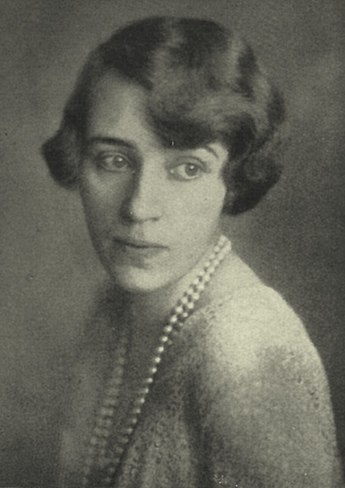
Translation: Copyright © Timothy Adès
More poems by Maria Luise Weissmann...